

1.0 Introduction
1.1 This is Coventry City Council's first report Adaptation Reporting Power (ARP) Report for submission to DEFRA. Coventry City Council is part of the Government’s Local Authority Pilot programme for ARP4. The Council is committed to working in partnership with various stakeholders in the private, public and voluntary sector in developing a more resilient city that can withstand and adapt to the effects of climate change.
1.2 This report summarises our efforts to integrate climate adaptation into our municipal planning and operating processes which are aimed at improving our adaptation to the effects of climate change and the strengthening of the city’s resilience for the benefit of community's wellbeing and infrastructure.
About Coventry
1.3 Coventry is a historic city located in the West Midlands approximately 19 miles east-southeast of Birmingham and 94 miles northwest of London.. The Meriden Gap, a green belt area, separates Coventry from Birmingham, highlighting its distinct geographical identity within the Midlands
It is the second-largest city in the region (after Birmingham), with a population at the time of the last census in 2021 of 345,324, with one of the fastest growing populations within the region an 8.9% increase over the past decade. While population projections are uncertain due to factors such as Brexit and the pandemic the number is currently estimated to be close to 450,000.
1.4 The City is also characterized by its youthful demographic, with a median age of 35 yrs, largely influenced by the presence of two universities (Coventry University & University of Warwick).
1.5 Two tributary rivers that are part of the River Avon Warwickshire Catchment (, the River Sherbourne and the River Sowe flow through the City. The source of the Sherbourne is approximately 13 miles North West of the City in Corley Moor and the Sowe flows from Bedworth some 5 or so miles North of the City. It must be said they are far from distinctive features in the Cityscape the water courses running through the City Centre are predominantly culverted and are therefore in the main, hidden from view. The drainage system is built to older standards and has not been upgraded and does not have sufficient capacity to deal with periods of high rainfall which overloads resulting in the increasing incidence of surface water flooding. The lack of a significant blue green infrastructure in the city centre is a clear disadvantage for creating a cooler atmosphere and microclimate for those area most at risk.
1.6 This growth rate surpasses both the national average and the regional average for the West Midlands. The city is characterized by its youthful demographic, with a median age of 35, largely influenced by the presence of two universities (Coventry University & University of Warwick). While population projections are uncertain due to factors such as Brexit and the pandemic, Coventry remains one of the fastest-growing populations in a local authority within the region.
1.7 Coventry's rivers face significant challenges regarding water quality and significant seasonal fluctuations in water levels with drought and flooding. There are also concerns regarding water quality. The city has experienced issues with wastewater discharge, including untreated sewage, which has led to increased levels of antibiotic-resistant bacteria downstream of the treatment works. This situation is exacerbated by the frequent discharge events that occur even during normal rainfall, indicating a cumulative overload on the sewage and wastewater systems.
1.8 Over the past decade, Coventry has faced several extreme weather to flooding and sewage overflow issues and over 10,560 properties in the city have been identified at risk of flooding, water levels in rivers and watercourses are low in the summer months so much so that businesses in both industry, leisure and agriculture will not be granted any new abstraction licenses during the summer months and extreme heat has disrupted rail passenger and freight services.
1.9 These events highlight the city's vulnerability to climate change impacts, necessitating the need for a robust adaptation and resilience strategy to address and where possible mitigate future risks. This has resulted in the City Council taking a leading role in developing a citywide Climate Adaptation and Resilience Strategy and Plan to fully understand climate vulnerability and develop a multi-agency plan to help adapt and mitigate against climate risks.
1.10 As a consequence of these identified risks and other concerns the City Council with the support of the Climate Change Board’s Adaptation and Resilience Pathway Group undertook a risk assessment based upon those identified national risks which the Group felt to be potentially applicable to the City area.
Organisational profile
1.11 Coventry is located in the West Midlands region of the United Kingdom and operates under a unitary authority governance structure with the West Midlands Combined Authority (WMCA). The city is administratively divided into 18 Wards, each represented by three elected members of Coventry City Council and has three civil parishes in Allesley, Finham and Keresley, the rest of the city is unparished.
1.12 In areas such as transport, economic development, and emergency services, where collaboration with the WMCA is essential, Coventry City Council focuses on local execution and detailed community-focused adaptation measures, while the WMCA addresses broader, regional strategies and infrastructure projects. Coventry borders with Warwickshire County Council, a non-constituent member of the WMCA and works to coordinate cross-border functions where appropriate.
Local responsibilities
1.13 The following are the responsibility of the City Council as a unitary authority
- Urban Planning and Development: The Council directly manages local urban planning initiatives, including the preparation and implementation of the Local Plan, land use zoning, local road maintenance, and small-scale flood defence systems within the city's boundaries.
- Community Services: The Council oversees public health, social services, and local education adaptations to climate impacts, ensuring that schools and healthcare facilities are resilient to climate-related disruptions.
- Transport: The Council is the Local Highway, Traffic and Streetworks Authority, responsible for the management of the local highway network. The WMCA is the Local Transport Authority, responsible for strategic transport matters including the Local Transport Plan and public transport services, as well as the Key Route Network. These responsibilities are discharged through Transport for West Midlands (TfWM). In addition, CCC liaises closely with Warwickshire County Council, the Local Highway Authority for Warwickshire, on cross boundary transport matters.
- Business Continuity: Coventry City Council plays a pivotal role in ensuring community resilience against the impacts of climate change. With increasing risks from extreme weather events such as flooding, heatwaves, and storms, Coventry City Council should consider climate adaptation strategies into their plans. This involves assessing potential vulnerabilities, protecting critical infrastructure, and ensuring that essential services can continue during disruptions.
Shared Responsibilities with WMCA
1.14 The following activities are a shared responsibility with WMCA as the Combined Authority
- Transport Infrastructure: While the Council manages the local road network and rights of way, the WMCA is the strategic transport authority responsible for the Key Road Network, public transport policy and services, and the preparation and implementation of the Local Transport Plan setting the overall policy direction. The City Council has a strong commitment to decarbonizing its transport system being the nation’s first ‘Electric Bus City’, developing a significant network of cycle superhighways, investing in the development of Very Light Rail (VLR) as well as having the highest proportion of EV charging points outside of London.
- Economic Resilience: Economic development initiatives related to climate adaptation, such as green job creation and business support during extreme weather events, are coordinated with the WMCA to leverage regional resources and funding, however there is a lot of activity supporting this at a more local level as part of the Council’s Economic Development Plan and Green Skills Strategy.
Scope of report
Coventry recently conducted a city-wide climate change risk and opportunity assessment aimed at identifying and understanding the broad spectrum of climate-related risks that could impact upon the city. This comprehensive assessment is crucial in recognising the various environmental challenges that Coventry faces today and anticipates in the future.
The ‘Climate Change Risk and Opportunity Assessment for Coventry’ has highlighted the important role the City Council plays in managing climate change risks. The City Council's involvement in climate change risk response extends beyond direct management of Council owner assets; it also encompasses significant facilitation and coordination roles. Consequently, the risks addressed in this Adaptation Reporting Power (ARP) report are not confined to Coventry City Council as an entity but are reflective of the broader community's interests and concerns. This report incorporates a detailed analysis of these wider risks, presenting a clear picture of the potential impacts on various sectors and demographics within the city.
Governance, management and strategy
1.15 The climate change risk reporting for Coventry forms part of the broader strategic planning framework known as the "One Coventry Plan." This overarching strategy aims to enhance the quality of life for its residents and boost the overall prosperity of the city. It outlines a collaborative approach involving the Council, its partners, and the community to deliver optimal outcomes for all city residents. The One Coventry Plan prioritises three main areas: boosting economic prosperity, enhancing community outcomes while reducing inequalities, and tackling the causes and consequences of climate change. It promotes innovative methods of working, focuses on key areas, and adheres to core values guiding the Council's actions.
1.16 Coventry’s Climate Change Strategy was developed as a key component of the One Coventry Plan [https://www.coventry.gov.uk/strategies-plans-policies/draft-one-coventry-plan/9]’. In November 2021, the formation of an independent Climate Change Board marked a significant step in the strategy's development and rollout. The Board brings together leaders from the public, private, and voluntary sectors to work on sustainable solutions. Its establishment is a demonstration of the City Council’s proactive approach to bringing various stakeholders together for effectively tackling complex environmental challenges. Over 25 voluntary, charitable, private and public bodies are currently active members of this independent partnership.
1.17 The strategy introduces five specific pathways, each aimed at addressing various climate and sustainability issues. The five pathways are integrated with one another where one inevitably impacts upon the other either in a negative of positive way. For example initiatives to create cooler areas such as turf roofs
1.18 The ‘Adaptation and Resilience Pathway’ is designed to enhance the city’s ability to handle and recover from the negative effects of climate change, like extreme weather conditions but some of the mitigation or adaptation measures can also help to enhance biodiversity e.g. the planting of trees or creating turf roofs etc which are beneficial to pollinator species whilst encouraging species diversity also helps to create cooler locations outdoors across the City. The Nature Based Pathway Group works closely with the Adaptation and Resilience Pathway Group in ensuring that the activities of one helps to benefit the other wherever possible. Similarly the Fairer Green Pathway Group is focused on ensuring that the work of the Adaptation and Resilience Pathway Group does not disadvantage certain members of the city population in anyway e.g. individuals who may be particularly vulnerable due to prevailing health conditions.
1.19 The Adaptation & Resilience Pathway focuses on developing infrastructure and systems capable of withstanding incidents such as floods, heatwaves, and severe storms. It outlines several action areas, with the primary activity being the development of a ‘Climate Change Adaptation and Resilience Strategy and Plan’. The detailed risk assessment informs the strategy, and it is intended to provide a robust overview of the city’s exposure to climate risks, assess preparedness to mitigate risks and an action plan in response to ensure that mitigation measures are delivered. The Plan pinpoints local areas vulnerable to flooding and affected by heat stress during the hot, dry summer months. The Plan also considers ways in which to adapt to the anticipated and likely changes in climate.
1.20 In order to implement this action area, the Sustainability and Climate Change service within the City Council have commissioned the development of a citywide climate adaptation and resilience strategy and action plan. The first step in this process involves carrying out a climate adaptation and resilience risk assessment to identify key risks and vulnerabilities.
2.0 Understanding risks and challenges
Risk assessment method
2.1 The Intergovernmental Panel on Climate Change Sixth Assessment Report (AR6) highlights that methods to analyse and assess climate risk vulnerability have advanced significantly over recent decades. According to the IPCC AR6, vulnerability is now understood to vary widely among different communities, contexts, and over time. The IPCC AR6 provides several definitions to aid in local-level climate risk assessment:
- Hazard is described as the potential occurrence of a natural or human-induced physical event or trend that could cause loss of life, injury, or other health impacts, as well as damage to property, infrastructure, livelihoods, service provision, ecosystems, and environmental resources. Examples include heatwaves, heavy rain, drought with associated wildfires, and surface water flooding.
- Risk is identified as the potential for adverse consequences for human or ecological systems, resulting from dynamic interactions between climate-related hazards and the exposure and vulnerability of the affected human or ecological system.
- Exposure involves the presence of people, livelihoods, species or ecosystems, environmental functions, services and resources, infrastructure, or economic, social, or cultural assets in places that could be adversely affected.
- Vulnerability refers to the propensity or predisposition to be adversely affected and includes various concepts and elements such as sensitivity or susceptibility to harm and the lack of capacity to cope and adapt.
2.2 These definitions formed the foundation for a method to assess climate risks and opportunities specifically for Coventry. To assess climate risks, it was crucial to first identify the likely climate change hazards facing the city, such as increased heat and changes in rainfall patterns. Once these hazards were identified, it was necessary to determine the extent to which the city or specific sectors within the city are exposed to these hazards. If exposure to a climate hazard was confirmed, the next step was to understand the vulnerability of the city or sectors to these hazards. Vulnerability assessment involved evaluating the sensitivity to the hazards as well as the capacity to adapt to them.
2.3 Different climate change scenarios were considered when identifying climate hazards. Data for the future climate projections was sourced directly from The UK Met Office climate data portal [https://climatedataportal.metoffice.gov.uk/] based on global warming levels [https://storymaps.arcgis.com/stories/1e9ba72a0b75473cb45a33c82cf23800] (GWLs). When considering timeframes for different GWLs, the Shared Socioeconomic Pathway SSP3-7.0 (See IPCC Table 1) [https://www.ipcc.ch/report/ar6/wg1/downloads/report/IPCC_AR6_WGI_TS.pdf] was used as the principal scenario when presenting possible climate futures for the City Council. The approximate timeframes for each GWL based on SSP3-7 are as follows:
- Baseline (1981-2000)
- Recent Past (2001-2020)
- 1.5°C change (2021 – 2040)
- 2°C change (2037 – 2056)
- 2.5°C change (2052 – 2071)
- 3°C change (2066 – 2085)
- 4°C change (2100 and beyond)
The focus of the detailed ‘Climate Change Risk and Opportunity Assessment for Coventry’ was for the GWL 2°C change scenario (2037 – 2056).
Alignment with ARP reporting requirement
2.4 The findings from the ‘Climate Change Risk and Opportunity Assessment for Coventry’ were used to populate this ARP Report. However, some adjustments were made to better align with findings with the ARP reporting requirements.
Likelihood and impact
2.5 As noted above, the concepts used to assess risk were exposure, sensitivity and adaptive capacity to give an overall vulnerability score. The ARP reporting guidelines suggest describing risks in terms of likelihood, impact and overall risk. To align with these requirements, data collected for exposure, sensitivity and adaptive capacity were used to define likelihood and impact. Likelihood was therefore defined and a combination of exposure to an existing risk as well as adaptive capacity to respond to that risk. Impact was defined as how sensitive an area or sector was to a particular risk.
Scenarios and timeframes
2.6 The ‘Climate Change Risk and Opportunity Assessment for Coventry’ focused specifically on understanding risks for the GWL 2°C change scenario (2037 – 2056). The ARP report guidelines suggest describing risks over a longer timeframe (e.g. end of the century). To score risks over different timeframe, three scenarios were reported on in the ARP Report, aligned to different GWLs. These three scenarios are summarised in Table 1.
| GWL | ARP 4 report scenario |
|---|---|
| 2°C change (2037 - 2056) | ARP 4 risk score – present to mid-century scenario (+2) |
| 3°C change (2066 – 2085) | ARP 4 risk score – mid to end of century scenario (+3) |
| 4°C change (2100 and beyond) | ARP 4 risk score - end of century scenario (+4) |
2.7 To update the risks to reflect future climate change risks, the following changes were made to the baseline risk assessment data.
Flood Risk Data. The ‘Climate Change Risk and Opportunity Assessment for Coventry’ determined flood using combination of Flood Zone 2, [https://www.data.gov.uk/dataset/cf494c44-05cd-4060-a029-35937970c9c6/flood-map-for-planning-rivers-and-sea-flood-zone-2] Flood Zone 3, [https://www.data.gov.uk/dataset/bed63fc1-dd26-4685-b143-2941088923b3/flood-map-for-planning-rivers-and-sea-flood-zone-3] 3.3 percent annual [https://www.data.gov.uk/dataset/95ea1c96-f3dd-4f92-b41f-ef21603a2802/risk-of-flooding-from-surface-water-extent-3-3-percent-annual-chance] chance [https://www.data.gov.uk/dataset/95ea1c96-f3dd-4f92-b41f-ef21603a2802/risk-of-flooding-from-surface-water-extent-3-3-percent-annual-chance] and 1 percent annual chance [https://www.data.gov.uk/dataset/8b82987d-3616-4e46-8edb-2973e8b82ad7/risk-of-flooding-from-surface-water-extent-1-percent-annual-chance] flood risk data to develop an overall flood risk profile which relates to the specific flood zones for fluvial and surface water incidents. To consider future additional flood risks for this APR report this flood risk profile was expanded to include 0.1 percent annual chance [https://www.data.gov.uk/dataset/1f3d6e13-40f1-4d12-99de-77132bc19c47/risk-of-flooding-from-surface-water-extent-0-1-percent-annual-chance] of flooding.
Urban Heat Island (UHI) Data. The ‘Climate Change Risk and Opportunity Assessment for Coventry’ determined UHI’s using data sourced from the Global Surface UHI Explorer from the Yale University Centre for Earth Observation. The UHI priority areas identified as those areas where there was an overall UHI >4° C of surrounding areas. To consider future additional UHI risks for this APR report this UHI profile was expanded to include areas with an overall UHI >3.5° C of surrounding areas.
Figure 1: Urban Heat Island map for Coventry
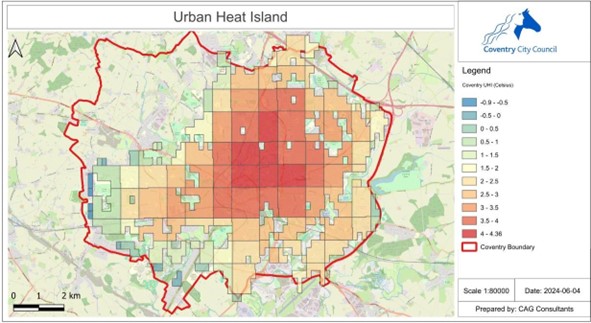
2.8 It is worth noting that obtaining granular data in relation to heat islands for Coventry was challenging. The temperature data provided through the Met Office was either not granular enough or only mapped long term changes in temperatures. A recent study by the University of Manchester has highlighted how significant the UHI risk is. It is noted that there are 69 priority neighbourhoods in need of adaptation to UHI’s in Coventry alone. Given the importance that local heat islands play in amplifying climate risks, there is a specific need to address these data gaps in future reporting processes.
Hazard identification and risk screening
2.9 An initial list of climate change risk was developed using the risks listed in the UK’s Third Climate Change Risk Assessment. Risks related to International Dimensions, any coastal or marine related risks, and some agricultural related risks were removed. The final list or risk included in the assessment is provided in Table 2. [#_bookmark2]
Table 2: Climate change risks for Coventry included in this assessment
| Risk no | Coventry risk or opportunity descriptor |
|---|---|
| N01 | Risks to terrestrial species and habitats from changing climatic conditions and extreme events, including temperature change, water scarcity, wildfire, flooding, wind, and altered hydrology (including water scarcity, flooding and saline intrusion). |
| N02 | Risks to terrestrial species and habitats from pests, pathogens and invasive species |
| N03 | Opportunities from new species colonisations in terrestrial habitats |
| N04 | Risk to soils from changing climatic conditions, including seasonal aridity and wetness. |
| N05 | Risks and opportunities for natural carbon stores, carbon sequestration from changing climatic conditions, including temperature change and water scarcity |
| N06 | Risks to and opportunities for agricultural and forestry productivity from extreme events and changing climatic conditions (including temperature change, water scarcity, wildfire, flooding, coastal erosion, wind and saline intrusion). |
| N08 | Risks to forestry from pests, pathogens and invasive species |
| N11 | Risks to freshwater species and habitats from changing climatic conditions and extreme events, including higher water temperatures, flooding, water scarcity and phenological shifts. |
| N12 | Risks to freshwater species and habitats from pests, pathogens and invasive species |
| N13 | Opportunities to freshwater species and habitats from new species colonisations |
| N18 | Risks and opportunities from climate change to landscape character |
Risk evaluation
2.10 The priority risks identified in the ‘Climate Change Risk and Opportunity Assessment for Coventry’ using exposure, sensitivity and adaptive capacity are provided in Table 3. [#_bookmark4] This table shows that food safety and food security is the main climate change risk for the city. Infrastructure and water availability are also key areas of vulnerability. High priority risks were only found in the Health, Communities and the Built Environment and Infrastructure risk themes. In general, more sensitive risks have higher overall vulnerability.
Table 3: Summary of climate related risks with highest vulnerability in Coventry, identified in the Climate Change Risk and Opportunity Assessment for Coventry.
| Risk and opportunity descriptor | Exposure score | Sensitivity score | Adaptive capacity score | Vulnerability score |
|---|---|---|---|---|
| Risks to food safety and food security | 2 | 3 | 1 | 4 |
| Risks to infrastructure networks (water, energy, transport, ICT) from cascading failures | 3 | 2 | 1 | 4 |
| Risks to public water supplies from reduced water availability | 3 | 3 | 2 | 4 |
| Risks to health and wellbeing from high temperatures | 1 | 3 | 1 | 3 |
| Risks to people, communities and buildings from flooding | 2 | 3 | 2 | 3 |
| Risks to water quality and household water supplies | 2 | 3 | 2 | 3 |
| Risks to health and social care delivery | 2 | 2 | 1 | 3 |
| Risks to education and care home services | 2 | 2 | 1 | 3 |
| Risks from climate change to role of urban ecosystems | 2 | 3 | 2 | 3 |
2.11 Table 4 shows the scoring of risks using the likelihood and impact scoring approach for the present to mid-century scenario. The results from this assessment closely match the scoring for exposure, sensitivity and adaptive capacity scoring used in the ‘Climate Change Risk and Opportunity Assessment for Coventry’.
2.12 Slight differences between these scoring methods are that risks to food safety and food security and risks to public water supplies from reduced water availability are rated at the same level, rather than risk to food security rating slightly higher.
2.13 There are two aspects of risks to food security a portion of which relates to uncertainty of global food supplies and their impact upon food production in other parts of the world combined with food prices. The actions to address such a wider risks relates to increasing provision via the food banks, whereas the promotion of local food growing of fresh vegetable food is about measures such as protecting growing areas and the health of soils from localised flooding and ensuring water supply during periods of drought etc.
2.14 Risks to infrastructure networks from cascading failures also score slightly lower when considering likelihood and impact and risks to businesses from flooding is also included as a new priority risk.
Table 4: Summary of priority climate risks in Coventry for the present to mid-century scenario (2°C change) using likelihood and impact scoring.
| Risk and Opportunity Descriptor | Likelihood Present to Mid Century | Impact Present to Mid Century | Risk Score Present |
|---|---|---|---|
| H09 - Risks to food safety and food security | Likely | Major | 16 |
| I08 - Risks to public water supplies from reduced water availability | Likely | Major | 16 |
| I01 - Risks to infrastructure networks (water, energy, transport, ICT) from cascading failures | Likely | Moderate | 12 |
| B01 - Risks to businesses from flooding | Possible | Major | 12 |
| H01 - Risks to health and wellbeing from high temperatures | Possible | Major | 12 |
| H03 - Risks to people, communities and buildings from flooding | Possible | Major | 12 |
| H10 - Risks to water quality and household water supplies | Possible | Major | 12 |
| H12 - Risks to health and social care delivery | Likely | Moderate | 12 |
| H13 - Risks to education and care home services | Likely | Moderate | 12 |
| N18 - Risks from climate change to role of urban ecosystems | Possible | Major | 12 |
2.15 Table 5 [#_bookmark6] shows the priority risks for the mid to end of century (3°C change) scenario. The results for mid to end century scenario show that risks city wide risks such as risk to health and wellbeing from high temperatures risks to people, communities and buildings from flooding are become more significant. The results also show that there are a number of additional priority risks (such as risks to bridges and pipelines from flooding and erosion and risks to freshwater species and habitats from changing climatic conditions.
Table 5: Summary of priority climate risks in Coventry for the mid to end century scenario (3°C change) using likelihood and impact scoring.
| Risk and Opportunity Descriptor | Likelihood Mid to End Century | Impact Mid to End Century | Risk Score Mid to End Century |
|---|---|---|---|
| H09 - Risks to food safety and food Security | Likely | Major | 16 |
| I08 - Risks to public water supplies from reduced water availability | Likely | Major | 16 |
| H01 - Risks to health and wellbeing from high temperatures | Likely | Major | 16 |
| H03 - Risks to people, communities and buildings from flooding | Likely | Major | 16 |
| B01 - Risks to businesses from flooding | Possible | Major | 12 |
| H10 - Risks to water quality and household water supplies | Possible | Major | 12 |
| N18 - Risks from climate change to role of urban ecosystems | Possible | Major | 12 |
| I01 - Risks to infrastructure networks (water, energy, transport, ICT) from cascading failures | Likely | Moderate | 12 |
| H12 - Risks to health and social care delivery | Likely | Moderate | 12 |
| H13 - Risks to education and care home services | Likely | Moderate | 12 |
| I04 - Risks to bridges and pipelines from flooding and erosion | Likely | Moderate | 12 |
| N11 - Risks to freshwater species and habitats from changing climatic conditions and extreme events. | Likely | Moderate | 12 |
2.16 Table 6 shows the risk profile for Coventry for the end of century scenario (4°C change). There is obviously a high degree of uncertainty in these results. They do however indicate that it is likely that the severity and range risks will increase with increasing global temperatures.
Table 6: Summary of priority climate risks in Coventry for the end century scenario (4°C change) using likelihood and impact scoring.
| Risk and Opportunity Descriptor | Likelihood End Century | Impact End Century | Risk Score End Century |
|---|---|---|---|
| H09 - Risks to food safety and food security | Almost certain | Major | 20 |
| I08 - Risks to public water supplies from reduced water availability | Likely | Major | 16 |
| H01 - Risks to health and wellbeing from high temperatures | Likely | Major | 16 |
| H03 - Risks to people, communities and buildings from flooding | Likely | Major | 16 |
| B01 - Risks to businesses from flooding | Likely | Major | 16 |
| H10 - Risks to water quality and household water supplies | Likely | Major | 16 |
| N18 - Risks from climate change to role of urban ecosystems | Likely | Major | 16 |
| I01 - Risks to infrastructure networks (water, energy, transport, ICT) from cascading failures | Almost certain | Moderate | 15 |
| H12 - Risks to health and social care delivery | Likely | Moderate | 12 |
| H13 - Risks to education and care home services | Likely | Moderate | 12 |
| I04 - Risks to bridges and pipelines from flooding and erosion | Likely | Moderate | 12 |
| N11 - Risks to freshwater species and habitats from changing climatic conditions and extreme events. | Likely | Moderate | 12 |
Priority risk summaries
2.17 The following section provides a summary of the priority risks for Coventry.
Risks to food safety and food security
2.18 Increased temperatures and extreme weather events pose significant risks to both food safety and food security in Coventry. Coventry is not immune to the global impacts of climate change on food production. Failures in grain harvests and other staple crops worldwide due to extreme weather can disrupt food availability in Coventry. This can lead to higher food prices, reduced nutritional quality, and greater difficulty in accessing essential food supplies. Coventry as a Marmot City already experiences dramatic inequalities with differences in life expectancy in the population as high as 10 yrs between those living in the most deprived neighbourhoods from those living in the most affluent parts of the city. Food is already a significant part of the expenditure for low-income families further price rises will result in a decline in the quality of the diet for low-income households with adverse health effects and greater susceptibility to diseases such as diabetes.
2.19 The local impacts of extreme weather also affect food production within Coventry, particularly for low-income families who rely on community gardens and allotments to grow their own food. Changes in temperature, rainfall, and the frequency of extreme weather events can reduce crop yields, affecting food availability for these vulnerable groups. Some allotments are prone to flooding resulting in loss of crops and hotter dry summers with periods of drought will also result in crop failure. In addition, rising temperatures increase the risk of food spoilage and the growth of harmful bacteria during storage, posing a significant food hygiene risk. Improperly stored food can lead to a higher incidence of foodborne illnesses, further straining public health systems.
2.20 Adapting through enhanced food safety regulations, improved food handling education, and robust monitoring of emerging risks can mitigate the impact on public health. Increasing resilience in food supply chains and ensuring robust food security monitoring can minimize costs and protect vulnerable populations from the adverse effects of climate change.
Risks to infrastructure networks (water, energy, transport, ICT) from cascading failures
2.21 Cascading failures occur when vulnerabilities in one infrastructure network causes problems in others, a risk that is exacerbated by extreme weather events and climate change. For example, a flood could lead to the failure of an electrical substation, which is already operating close to capacity. Since water supply in Coventry is 100% electrically pumped, this would result in an immediate disruption to water services. The lack of backup capacity means that this failure could not be quickly mitigated, leading to widespread water shortages. Furthermore, the disruption to the energy network could cascade to other critical services, such as transport and ICT, causing further chaos. For instance, traffic management systems and communications networks could fail, leading to gridlock on the roads and loss of communication capabilities. This interconnected vulnerability highlights the importance of enhancing the resilience of each network to prevent such cascading failures, especially as extreme weather events become more frequent and severe.
2.22 Coventry relies on resilient infrastructure networks for its economy, public safety, and daily life. Disruptions can lead to widespread impacts, affecting thousands in urban areas like Coventry. Proactive adaptation measures, such as enhancing resilience of electricity substations protecting them from flooding using bunding or controllable structures such as flood gates raising cable connections with bentonite on earth mounds or using plinths to raise cabling above ground level and other proprietary methods. Better information sharing among Local Resilience Forums, are essential to minimize disruptions and ensure stable operations across essential services.
Risks to public water supplies from reduced water availability
2.23 Reduced water availability due to climate impacts such as increased temperature and reduced summer rainfall, impacting river flows and groundwater recharge. Coventry's public water supply is crucial for domestic, industrial, and agricultural needs. A deficit impacts daily life, economic activities, and ecological balance.
2.24 Adapting to water scarcity by improving water use efficiency across households and businesses including basic measures such as grey water harvesting in new developments and where possible in retrofits, rainwater collection replacing leaking lead pipes to households with new supply pipes to collecting water from roofs with water butts connected to downpipes, use of trickle irrigation systems, enhancing the water treatment capacity at Finham and enhancing supply infrastructure will ensure sustainability and resilience against future climate variability. Increasing the potable water storage capacity at Draycott Water and from Buxton for supply to Coventry and surrounds Draft Water Resources Management Plan 2024 [https://www.severntrent.com/content/dam/dwrmp24-st/STdWRMP24-Main-Narrative.pdf] to accommodate a 12% growth in population and demand thus preventing a 540million litre/day shortfall in a water supply from the Company by 2050 across the Severn Trent Region .
Risks to health and wellbeing from high temperatures
2.25 High temperatures lead to increased illness or mortality, particularly among vulnerable populations like the elderly. This risk is compounded by concurrent crises, such as the COVID-19 pandemic, and exacerbated by the urban heat island effect and poor ventilation in homes.
2.26 Coventry, along with other UK cities, experiences increasingly frequent and intense heatwaves, which can severely impact upon public health, especially in densely populated urban areas. This risk is aggravated by the urban heat island effect and poor ventilation and insulation in homes.
2.27 The Regional study carried out by WMCA suggests that a heatwave incident is highly likely with a 59% chance of at least one event lasting up to 5 days per year rising to 70% by 2050.with an 18% chance of an event serious enough to trigger an Amber Heat Health Alert each year rising to 25% by 2050 assuming a 20C rise in average temperature.
2.28 According to the Grantham Institute's "Turning up the Heat [https://www.lse.ac.uk/granthaminstitute/publication/turning-up-the-heat/]" report, England is ill-prepared for extreme heat events. The report highlights that over half of UK homes are at risk of overheating, with a lack of comprehensive strategies to address this growing threat. The report also notes that in 2022 heatwaves were associated with 2,985 excess deaths in England and cost the UK economy and estimated £260 - 300 million per year. A recent University of Manchester study [https://policy.friendsoftheearth.uk/download/data-neighbourhoods-vulnerable-heat-england] has also noted that Coventry ranks as the local authority with the 14th highest number of neighbourhoods in England that are vulnerable to heat.
2.29 This under-preparedness, combined with Coventry’s increasing frequency and intensity of heatwaves, underscores the urgent need for robust heat risk management to protect public health.
2.30 It is essential to begin adapting to minimize heat-related health risks, particularly for those most vulnerable. This includes improving building designs to enhance thermal efficiency without compromising air quality or increasing moisture levels. Proactive measures, like setting overheating standards in residential buildings and promoting better ventilation and shading practices within buildings and exterior landscaping, can significantly reduce the adverse health outcomes associated with high indoor temperatures. Additionally, community awareness programs on managing heat stress could enhance resilience. A number of air source heat pumps which are on the market can also be used for cooling. Unfortunately grants from the UK Government for retrofitting air source heat pumps at present does not allow the use of grant funding to assist with cooling. Will make the case for considerations to be made for the use of technology for cooling as part of the assessment process for the new devolved energy funding regime with the WMCA.
Risks to people, communities and buildings from flooding
2.31 The risk of flooding affects people, communities, and buildings significantly due to river, surface and groundwater sources. Flooding impacts include physical damage to properties, potential loss of life and substantial economic costs. Additionally, flooding exacerbates mental health issues like anxiety, post-traumatic stress disorder (PTSD), and depression among affected populations.
2.32 Coventry is particularly vulnerable to flooding from various sources, including river, surface water, groundwater, and sewer systems. Notable areas frequently impacted by flooding include communities along the River Sherbourne, which has experienced repeated fluvial flooding incidents. Additionally, surface water flooding is a significant concern in urban areas such as Earlsdon and Tile Hill, where heavy rainfall can overwhelm drainage systems, leading to waterlogging and property damage. The Coventry Canal and Coombe Pool also pose flood risks due to overtopping or structural failures, which could severely impact nearby properties and infrastructure.
2.33 Proactive adaptation measures are necessary to mitigate risks. This includes tackling flooding at source in upstream catchments to both slow and reduce flow, flood defences, property resilience measures, drainage improvements and integrating Sustainable Drainage Systems (SUDS) in public realm, parks, public highway corridors and tackling urban creep. These steps can significantly reduce the potential physical and economic damage from future flooding events and will require collaboration with neighbouring authorities. A Partnership is already in place for emergency planning which includes Solihull and Warwickshire County Council, and the Partnership is involved in the development of the Adaptation and Resilience Plan which is currently being worked on by all concerned.
Risks to water quality and household water supplies
2.34 Climate change is likely to lead to reduced summer precipitation and increase the likelihood of water scarcity and droughts. This can interrupt household water supplies and degrade water quality, potentially leading to health risks from waterborne pathogens like Cryptosporidium and E.coli, and increased incidents of harmful algal blooms.
2.35 In cities like Coventry, the health risks associated with poor water quality and supply are significant, especially for vulnerable populations. Interruptions in water supply and contamination can lead to widespread health and social issues, straining public health systems and economic stability.
2.36 Adapting to these risks involves improving water infrastructure to handle heavy rainfall and prevent flooding, implementing water-saving measures, the introduction of increased water filtering using retrofit natural and non-natural sustainable drainage solutions in public highway corridors and parks, reducing urban creep together with strengthening water quality improvements in new developments. These actions can mitigate health risks, ensure a stable water supply, and reduce potential economic and social disruptions. The use of SUDs will also help to encourage natural rates of filtration and helping to reduce the runoff of potential pollutants into water courses which would otherwise have an adverse impact upon the ecology of water courses with a loss of biodiversity within freshwater habitats.
Risks to health and social care delivery
2.37 Climate change increases the risk of extreme weather events such as floods and heatwaves that can damage health and social care facilities and disrupt services. This includes overheating of hospitals and care homes, flooding risks to healthcare infrastructure, and impacts on transport and ICT systems essential for care delivery. These effects increase the demand for health services due to the direct impacts on people's health and wellbeing.
2.38 In Coventry, where health and social care infrastructure might be vulnerable, the robustness of these services is crucial for public safety, especially given the projected increase in frequency and severity of extreme weather events. The disruption of these services can have severe immediate health impacts and long-lasting social consequences.
2.39 Adapting to these risks means enhancing the resilience of healthcare buildings against overheating and floods, improving emergency response capabilities, and designing new facilities with future climate scenarios in mind. This includes using building materials and designs that are resilient to extreme weather, and planning healthcare delivery to accommodate increased demands during and after climate events. Strategic and localized adaptation actions are essential to safeguard health and social care services from future climate impacts this should include retrofitting measures where possible with a focus on what can be done within buildings and their exteriors.. Training for social care workers and staff conducting home visits is also crucial. These professionals should be equipped to provide practical, low-cost advice on keeping homes cool during heatwaves. This includes guidance on effective use of ventilation, shading, and simple cooling techniques.
Risks to education and care home services*
2.40 Climate-related risks to education and care services in Coventry are significant and complex. Overheating in schools and care homes can impair learning and cognitive performance in children and heighten discomfort and health risks for elderly residents. Increased flooding risks can disrupt the operations of these essential services.
2.41 Heat stress particularly impacts vulnerable groups, including young children, the elderly, and those with medical conditions such as Chronic Obstructive Pulmonary Disease (COPD) and heart disease. Staff working in schools, nurseries, care homes, and community outreach services need to be particularly vigilant in these conditions.
2.42 Beyond education and care homes, other critical services, including those supporting people in their homes, must also adapt to these climate-related challenges. This means updating building designs and infrastructure across a broader range of services to effectively manage heat and flood risks. In Coventry, it is essential that facilities, whether educational, residential, or community-based, remain safe and functional under future climate scenarios.
2.43 Adapting to these risks requires a comprehensive approach that includes implementing heat management strategies, improving flood resilience, and ensuring continuity of services. Strategic planning is key to maintaining the resilience of Coventry’s educational and care systems.
2.44 Additionally, specific training for staff is essential. This training should cover how to address heat stress and other climate-related challenges within facilities and provide guidance on helping individuals and families manage during extreme temperature events.
*The national risk descriptor for this risk is “Risks to education and prison services”. However, there are no prisons or offender institutions in Coventry. We have amended this risk to include care homes as they are a particularly important facilities with vulnerable elderly residents most affected by extreme heat.
Risks from climate change to role of urban ecosystems
2.45 Climate change poses significant risks to urban ecosystems through increased temperatures, pollution, habitat degradation, and the spread of invasive species. These factors can lead to a decline in biodiversity and affect ecosystem services in Coventry, a city already facing challenges with blue and green infrastructure.
2.46 While biodiversity is important, the focus should be on developing ecologically sensitive approaches that mimic natural ecosystems. This strategy can reduce the need for costly interventionist land management practices. By creating systems that are closer to natural ecosystems, we can enhance resilience against climate impacts such as heatwaves and flooding, while potentially improving air quality, water quality and providing recreational spaces.
2.47 In some cases, the use of non-native, climate-adapted species may be appropriate, particularly in areas facing heat stress and low water availability. These species can survive in challenging conditions and contribute to cooling urban areas. The Forestry Commission for example recommends changes in provenance of genetic stock using seeds from trees located 2 degrees south of the Coventry location which are closer to the projected climate for the city in the not-too-distant future.
2.48 Adapting to these risks will strengthen Coventry's resilience against climate impacts, potentially improve quality of life for residents, and create a more sustainable urban environment. This approach balances ecological considerations with practical, cost-effective solutions for climate adaptation.
3.0 Adaptation action plan and implementation
3.1 Coventry City Council has developed a climate change adaptation and resilience strategy and action plan. The development of the Strategy and Plan is being supported by Coventry’s independent Climate Change Board’s Adaptation and Resilience Pathway Group (ARPG) which consists of representatives from a number of key stakeholders all of whom have an interest in promoting adaptation and resilience. The Group is currently chaired by a senior representative from the Environment Agency.
3.2 This strategy and action plan provides a comprehensive framework for the city of Coventry to adapt to and address the impacts of climate change. The document places the adaptation strategy and action plan within the context of broader local, regional, and national climate initiatives, explaining how it fits into existing climate change and resilience planning efforts in Coventry.
3.3 The strategy and action plan defines principles and processes for implementing the strategy. These include guiding principles and practical steps for effective action. The strategy emphasizes:
- a coordinated integrated approach – focusing on the need for organisations and stakeholders in the city to work together and to share resources and activities which improve the overall effectiveness in being adaptable and resilient;
- a people-centred locality sensitive approach – focusing on the needs and involvement of the community in a way which is sensitive to the different circumstances which may exist across the city;
- an ecologically sensitive approach – maximising the opportunity of working with nature to enhance biodiversity which making locations more adaptable and resilient.
- a resilient development approach – which highlights the importance of innovative solutions and sustainable practices which focus on changes in ways areas are maintained as well as designed.
3.4 A detailed adaptation implementation plan outlines the specific actions required to address high-priority risks, followed by actions for addressing medium-priority risks. These sections provide actionable steps to enhance the city's resilience and ensure a sustainable future for Coventry.
3.5 The implementation plan outlines systems and structures for its implementation. Implementing the plan will require participation from a range of different stakeholders and experts across many sectors. Coventry City Council is in a strong position to ensure regular engagement with key stakeholders who have a role to play in delivering the priority actions in the adaptation strategy through its well-established Adaptation and Resilience Pathway Group (ARPG). The ARPG has representation from a number of sectors and key stakeholders that are currently actively involved in climate change adaptation and resilience initiatives. This collaborative structure has created a foundation for ensuring active participation by a wide range of stakeholders in the successful delivery of the adaptation strategy and implementation plan.
3.6 The implementation plan is divided into three sections with categories of action for promoting adaptation and resilience:
- Enabling action are higher level, cross sectoral actions that need to take place for the strategy to be implemented.
- Addressing the ‘High Priority’ climate risks identified in the risk and opportunity assessment.
- Address the identified ‘Medium Priority’ climate risks identified in the risk and opportunity assessment.
3.7 The Actions listed below are currently in draft with a proposal for members of the Pathway Group to consider the resources for implementation and their current status some actions are for immediate implementation whilst other will need to be planned for or for bids for external funding to be secured or more detailed business cases to be made to make certain aspirations a reality. The Group intends to finalise the Strategy and the planned actions for the coming years early in the new year for consideration and approval from the City Council’s Cabinet Members.
3.8 The column in the tables for High and Medium risk categories 1 & 2 (listed from pages 33 to 55) relates to whether they are actions requiring an immediate action or require further deliberation.
| Action description | Owner | Possible Partners | Action type | Estimated costs | Resource Intensity | Priority | Timeframe |
|---|---|---|---|---|---|---|---|
| Create a specific Terms of Reference for the Adaptation and Resilience Pathway Group (ARPG) to focus on the implementation of the adaptation strategy and priority adaptation actions |
CCC Sustainability & Climate Change team |
ARPG | Management | None – CCC staff | Low | High | December 2024 |
| Action description | Owner | Possible Partners | Action type | Estimated costs | Resource Intensity | Priority | Timeframe |
|---|---|---|---|---|---|---|---|
| Recruit or assign a Climate Change Adaptation Officer to lead the strategy and implementation of the Plan |
CCC Sustainability & Climate Change team |
CCC | Management | c£50,000 per year | Low to Medium | High | December 2026 |
| Action description | Owner | Possible Partners | Action type | Estimated costs | Resource Intensity | Priority | Timeframe |
|---|---|---|---|---|---|---|---|
| Assign the responsibility within the ‘Adaptation & Resilience Pathway Group’ (ARPG) to identify, communicate and support applications to funding opportunities for climate adaptation projects. | ARPG | ARPG | Access to Funding | Staff time | Low | High | August 2027 |
| Action description | Owner | Possible Partners | Action type | Estimated costs | Resource Intensity | Priority | Timeframe |
|---|---|---|---|---|---|---|---|
| Manage (update, maintain and expand) a database of climate adaptation projects for Coventry using this adaptation action plan as a basis | ARPG | CCC, Sustainability & Climate Change team, ARPG Members | Management | None – ARPG and CCC staff | Low | High | Ongoing |
| Action description | Owner | Possible Partners | Action type | Estimated costs | Resource Intensity | Priority | Timeframe |
|---|---|---|---|---|---|---|---|
| Manage (update, maintain and expand) a data repository (including GIS Data) of climatic and environmental conditions relating to climate change and extreme weather events over time | CCC ARPG |
CCC Sustainability & Climate Change team, ARPG Members |
Management |
£50,000 (external researchers) |
Low | High | Ongoing |
| Action description | Owner | Possible Partners | Action type | Estimated costs | Resource Intensity | Priority | Timeframe |
|---|---|---|---|---|---|---|---|
| Involve young people in the ARPG and facilitate including climate adaptation as a theme in Youth Boards/Councils | ARPG |
CCC Sustainability & Climate Change team |
Co-ordination | None – ARPG and CCC staff | Low | Medium | Ongoing |
|
Action description |
Owner |
Possible Partners |
Action type |
Estimated costs |
Resource Intensity |
Priority |
Timeframe |
|---|---|---|---|---|---|---|---|
|
Conduct training sessions to help businesses and 3rd sector organisations develop their own climate risk assessments and adaptation plans. |
CCC Sustainability & Climate Change team |
ARPG |
Awareness Raising & Behaviour Change |
£50 000 (external training providers) |
Low to Medium |
Medium |
Aug 2027 |
Actions to addressing high priority risks
| Action title | Action description | Owner | Possible Partners | Action type | Estimated costs | Resource intensity | Category | Timeframe |
|---|---|---|---|---|---|---|---|---|
| Advice and support to reduce risk of heat effects particularly on vulnerable households | Raise awareness of frontline staff involved in social care and health in children’s services on the effects of extreme heat on people with vulnerable conditions so they can provide advice and support to the households they visit. To run marketing and communications/ public messaging campaigns to promote behaviours that will reduce risk of exposure |
CCC NHS Schools |
Local media, NHS, Academy trusts, community organisations, care homes | Local delivery, advice and support | Low | Low | 1 | December 2025 |
| Use Chartered Institute of Building Services Engineers (CIBSE ) resources [https://www.cibse.org/policy-insight/position-statements-and-briefings/overheating-position-statement] to assess the thermal performance and energy efficiency of new developments | Use Chartered Institute of Building Services Engineers’ (CIBSE’s) guidance, such as Technical Memorandum 59 (TM59 [https://www.cibse.org/knowledge-research/knowledge-portal/technical-memorandum-59-design-methodology-for-the-assessment-of-overheating-risk-in-homes?id=a0q0O00000DVrTdQAL]) for assessing overheating risk in new homes |
CCC Planning CCC Property Services |
CIBSE | Local planning and policies | None - CCC staff | Low | 1 | December 2026 |
| Establish community cooling centres | Research the possibility of converting public buildings into cooling centres during heat waves to provide relief for vulnerable populations (similar to the Warm Spaces initiative) | CCC Community Resilience |
- | Research and data collection | None -CCC staff | Low | 1 | December 2026 |
| Expand tree planting initiatives | Consolidated existing tree planting initiatives (such as planting trees alongside paths to provide shading and using urban Tree Challenge fund and LA tree fund) into a long-term programme | CCC Ecology | Woodland Trust | Local planning and policies | None - CCC staff | Low | 1 | Ongoing |
| Creating new green spaces, turf roofs and living walls | To create new opportunities for green spaces in place of concrete and tarmac where practical and where possible encourage the development of turf roofs and living walls in new development or retrofit projects especially in inner city hot spots. Also consider use of different materials to reflect radiated heat |
Planning & Sustainability Team |
Planning Coventry University Citizen Housing |
Local planning and policies | To be established on a case by case basis with potential funding from Section 106 or Biodiversity Net Gain etc. where appropriate | Medium to high depending upon project locations etc. | 1 | Ongoing |
| Develop a detailed Urban Heat Island (UHI) map for Coventry | Develop a UHI map that can be used to more accurately identify areas at risk from high temperatures to enable effective targeting of actions for communities at risk and to assist in prioritising locations. To use a liveable neighbourhoods approach which prioritises urban greening for improved street design |
CCC Climate Change Team WMCA |
University of Birmingham, Met Office | Research and Data Collection | WMCA securing funding for the development of a heat map of the region with granular detail down to neighbourhood level to help identify locations and types of interventions to help improve architecture and urban design to help cool locations down | Low resource funded through UKRI and University of Birmingham | 1 | December 2026 |
| Maximise the opportunity to use surfacing and street designs that promote a cooler environment, when carrying out improvements to streets | Optimising the design of small green spaces through the use of microclimate modelling for smaller localized areas to create cooler neighbourhoods using new surface materials, vegetation and building structures aligning spaces with wind flow etc. | CCC | Developers | Research and modelling Project implementation |
Establish costs for developing an SPD Developing projects on a case-by-case basis |
Low | 1 | December 2027 |
| Action title | Action description | Owner | Possible Partners | Action type | Estimated costs | Resource intensity | Category | Timeframe |
|---|---|---|---|---|---|---|---|---|
| Ensure the measures from the Environment Agency Flood Risk Management Plans, Coventry Flood Risk Management Plan (FRMP) and Strategy (LFRMS) and Coventry Surface Water Management Plan (SWMP) are implemented and under frequent review | Track and report on progress on the implementation of the Flood Risk Management Plan (FRMP), the Local Flood Risk Management Strategy (LFRMS) and the Surface Water Management Plan (SWMP) | CCC – Flood Risk Management | Solihull Metropolitan Borough Council, Warwickshire County Council, Environmental Authority (EA), Canal and Rivers Trust | Risk assessment and data gathering | None – CCC Staff for reporting progress (however implementation of the FRMP, LFRMS and SWMP includes significant costs requiring external bids to national fund sources.) | High | 1 | Ongoing |
| Slowing rates of flow from front drives and gardens | To Pilot approaches to encourage households to retain vegetation and porous surfaces in front gardens and driveways to preserve the streetscape to accommodate vehicles whilst enabling the slowing down of the rates of flow of water from front drives and thus reducing the risk of flooding and the provision of shelter | CCC | Severn Trent Garden Organic Coventry University Royal Horticultural Society (RHS) |
Piloting awareness raising guidance Development of pilot initiatives funded through Section 106 or other contributions from developers or grant making trusts etc. |
Awareness raising materials and publications etc Funding of pilot front driveways and gardens Dependent upon size of scheme also supporting households who may fund themselves especially if this proves to be a cheaper viable option |
Low to Medium | 1 | 2027 |
| Action title | Action description | Owner | Possible Partners | Action type | Estimated costs | Resource intensity | Category | Timeframe |
|---|---|---|---|---|---|---|---|---|
| Support the take up of existing food provision systems | Ensure mechanisms are in place for people to take up their entitlement for free school meals and the holiday activities and food To learn from the Warwickshire County public health model and promote the benefits in the ‘Food for Life programme to local schools across the city |
CCC Universal Services and CCC Revenues and Benefits |
Local Schools Garden Organic Food Network Housing Associations NHS |
Local Planning and Policies | None- CCC staff | Low to medium | 2 | August 2027 |
| To promote the use of the food waste collection service and raise public awareness of ways to minimise food waste | To enhance food waste participation rates and the amounts collected help to raise awareness leading to more efficient use of food including the use of wonky vegetables that are disposed of as waste due to their unconformity in shape. Promoting practical skills to assist families in cooking fresh food in order to avoid costlier prepared meals and how to preserve food and store it safely at the right temperature | CCC | Food network | Awareness Raising and Behaviour Change | Not known at this stage potential bid for external funding for innovatory approaches to tackling issues concerned with a particular focus on deprived neighbourhoods | Low | 2 | December 2027 |
| Identify areas for additional local food production | Identify locations and map sites for community gardens and food growing (including neglected open spaces) and link to community and networks and allotment groups | CCC Parks Service | Federation of allotments, Community Groups Garden Organic |
Research and Data Collection | £20 000 (external mapping consultants) |
Low to medium | 1 | December 2026 |
| Implement urban agriculture programme and supporting the development of social enterprises to sustain food production and distribution to families in need | Launch a programme to promote the conversion of underutilised urban spaces using creative approaches such as use of roofs and vertical growing opportunities (e.g. living walls) for the creation of productive gardens and farms, promoting local food production to improve food security, reduce transportation emissions, and provide fresh produce to the community | CCC Parks Service Sustainability & Climate Change Team |
Federation of allotments Community Groups Garden Organic The Pod Developers, urban designers and architects |
Awareness Raising and Behaviour Change Development projects |
Seek funding C£50 000 (communication materials, workshops) Development funding for works on the ground |
Low to medium | 1/2 | December 2026 |
| Support community food hubs by making local grown fresh produce available to those in need | Work in partnership to continue to support local food banks and food hubs that provide safe and affordable food, enhance local food distribution networks, and include educational workshops on food safety and sustainable cooking practices. Develop closer relationships with the food industry and supermarkets to promote access to affordable fresh produce and other foods |
Coventry Food Network | Coventry Council, Local NGOs | Awareness Raising and Behaviour Change |
Seek funding to develop further support for access to food particularly for vulnerable members of the community C£50 000 |
Low to medium | 1 | December 2026 |
| Promotion in the reduction of food waste | Promote the food waste collection service and promote awareness of the need for the reduction of sources of food waste including preventing wastage from storage depots and distribution centres. To consider initiatives like Fareshare, the City Harvest and Felix Project in London | CCC | Food Network Adult Education |
Awareness Raising and Behaviour Change R&D liaison with external organisations like Sustain |
Seek funding for community based and citywide initiatives with statutory agencies working with the third sector | Requires further research and fact finding from best practice exemplars and learning from others with practical experience | 2 | December 2028 |
| Action title | Action description | Owner | Possible Partners | Action type | Estimated costs | Resource intensity | Category | Timeframe |
|---|---|---|---|---|---|---|---|---|
| Identify funding for water conservation products in public buildings | Identify capital funding to install water conservation products (e.g. rainwater harvesting systems or water butts) in public buildings such as schools and council buildings to demonstrate reduced reliance on main water supplies and promote water conservation | CCC – household water users Severn Trent Water – non-household water users |
Coventry Council, Schools, Severn Trent Water | Fund access |
To seek funding based upon earlier considerations £15,000 (pilot of 50 buildings at £3000 per kit) |
Medium to high | 2 | August 2027 |
| Improve the visibility of public water quality information | Collect and review existing public information on water quality around Coventry and identify information gaps where sampling might be required | Severn Trent Water |
CCC Environment Agency |
Monitoring and Evaluation | None – STW staff | Low to medium | 1 | December 2027 |
| Action title | Action description | Owner | Possible Partners | Action type | Estimated costs | Resource intensity | Category | Timeframe |
|---|---|---|---|---|---|---|---|---|
| Retrofit health facilities to be climate smart | Conduct an assessment of the requirements to upgrade existing hospitals, Clinics GP Practices and care homes with heat-resistant and flood- resistant materials, install advanced cooling systems, and improve drainage systems to handle extreme weather events |
CCC & NHS Resilience (coordinator) |
NHS | Research and Data Collection |
Identify risks associated with buildings and the priorities To identify resources and inform estates management programme to plan in the long term to address issues within those facilities which present the greatest risk |
High | 2 | August 2027 |
| Conduct emergency response training |
Continue to regularly train health and social care staff on emergency protocols for extreme weather, including evacuation and patient care during heatwaves and floods. Include guidance for carers and frontline staff to confidently advise vulnerable individuals on managing home temperatures during extreme heat, cold, or heavy rainfall |
CCC (Public Health & Adult Social care) Resilience (coordinator) |
NHS | Capacity building | None - CCC and NHS staff | Low | 2 | August 2027 |
| Action title | Action description | Owner | Possible partners | Action type | Estimated costs | Resource intensity | Category | Timeframe |
|---|---|---|---|---|---|---|---|---|
|
Develop a Climate-Adaptive School Network |
Build on the Coventry Eco Schools and Coventry Green Awards Scheme to create a network of schools that share best practices and resources for adapting to climate change impacts. |
CCC Services for Schools |
Academies, Faith Schools, Colleges and Nurseries |
Collaboration |
£20 000 (Network set up and communication materials) |
Low to medium | 2 | August 2027 |
| Pilot climate resilience audits in schools | Set up a programme to perform regular audits of pilot school buildings to assess and improve their resilience to climate change impacts. |
CCC Services for Schools |
Pilot schools, Universities (to conduct audit) | Monitoring and Review |
£30 000 (10 schools @£3000/audit) |
Low to medium | 2 | August 2027 |
| Coordinate tree planting fund applications with schools |
Coordinate a programme to support fund applications for a school’s tree planting programme (e.g. through the Woodlands Trust [https://www.woodlandtrust.org.uk/plant-trees/schools-and-communities/]). This will increase tree planting around school premises to provide shade, reduce heat islands, and improve air quality. |
CCC Ecology | Woodland Trust, Local School, Academies, Faith Schools, Colleges and Nurseries | Collaboration | None – CCC and School Staff | Low | 2 | August 2027 |
| Action title | Action description | Owner | Possible Partners | Action type | Estimated costs | Resource intensity | Category | Timeframe |
|---|---|---|---|---|---|---|---|---|
| Establish Integrated Infrastructure Resilience Forum | Create a sub-group within the ARPG that brings together key stakeholders from energy, water, transport, and ICT sectors to coordinate and enhance resilience planning. This should align with activities of the Adaptation Infrastructure Forum. | ARPG | CSW Resilience CCC Resilience, Transport for West Midlands, West Midlands Resilience Forum, National Highways, Network Rail |
Coordination | None- ARPG | Low | 1 | December 2026 |
| Conduct research on how connected data across different infrastructure systems can improve climate reliance | Develop a climate change adaptation digital twin to assess the potential impact of flooding caused by climate change on energy, water and telecoms networks (e.g. CREDO [https://digitaltwinhub.co.uk/climate-resilience-demonstrator-credo/]) | CCC Community Resilience |
ARPG, CCC Climate Change |
Monitoring and evaluation | £50,000 (Digital twin development) | Low to medium | 1 | December 2026 |
| Action title | Action description | Owner | Possible partners | Action type | Estimated costs | Resource intensity | Category | Timeframe |
|---|---|---|---|---|---|---|---|---|
| Conduct research on the impacts of climate change on water use and supply. | Utilise the next stage of Water Resources Management Plan development to further understand links between climate, water use and supply.” We do not know at this stage how geographically granular our analysis will be or what arrangements there will be set in place to share the data outputs with other parties. | Severn Trent Water | CCC | Research and Data Collection | None -STW staff | Low | 1 | Dec 2028 |
| Coordinate the roll out of water saving campaigns to households and businesses across Coventry. | Working with Coventry City Council Severn Trent is looking to align messaging and campaigns related to efficiency of water use. This could include behaviour change programmes in schools and universities. Community key messages to improve the efficiency of water use and helping people to identify ways to reduce the levels of unnecessary water consumption. | Severn Trent Water | CCC | Awareness Raising and Behaviour Change | None - STW staff | Low | 1 | Dec 2028 |
Actions to addressing medium priority risks
| Action title | Action description | Owner | Possible Partners | Action type | Estimated costs | Resource intensity | Category | Timeframe |
|---|---|---|---|---|---|---|---|---|
| Establish a Business Climate Change Resilience Forum | Create local resilience business forum to share networks (such as Business Growth West Midlands), information, resources, and best practices, training, tools (such as Business Resilience Healthcheck Tool) and support sessions | CCC - Flood Risk Management and Warwickshire Chamber of Commerce | CCC (Business Development), Resilience, WMCA businesses support | Coordination | None – Chamber and CCC Staff | Low | 2 | August 2027 |
| Develop flood resilience grants programme | Identify any grant funding opportunities to support businesses in enhancing flood mitigation and resilience measures, such as flood barriers and raised electrical systems | CCC Flood Risk Management |
CCC Resilience, WMCA business Support, Environment Agency River Severn Trust |
Coordination | Contract staff in combination with CCC Staff. £90,000 | Low | 2 | August 2027 |
| Implement business flood preparedness audits | Identify high risk and conduct audits of these business premises to assess flood risk and recommend improvements, providing businesses with tailored flood risk management plans | CCC Flood Risk Management | Local Businesses | Research and Data Collection | £100,000 (10 businesses at 10 000 per audit) | Low to Medium | 2 | August 2027 |
| Action title | Action description | Owner | Possible Partners | Action type | Estimated costs | Resource intensity | Category | Timeframe |
|---|---|---|---|---|---|---|---|---|
| Promote flexible work arrangements | Develop and promote policies that allow flexible work hours and remote work options during extreme heat events to reduce exposure and maintain productivity | CCC(personnel) NHS (awaiting confirmation) |
CCC | Awareness raising and behaviour change | None – CCC Staff | Low | 2 | August 2027 |
| Launch heat- resilient workplace grants programme | Identify and promote grants to support businesses in implementing heat-resilient modifications, such as installing energy-efficient cooling systems and improving insulation and green infrastructure such as trees for shading and ensuring there is a garden or open green space within 300m of the work location | CCC Business Development |
Businesses, WMCAs, Energy Capital team | Local Planning and Policies | None – CCC Staff | Low | 2 | August 2027 |
| Develop a heatwave health and safety training programme | Create a training programme for employees and employers on health and safety practices during heatwaves, including recognising heat stress symptoms and first aid | NHS | CCC Business Development |
Awareness raising and behaviour change | None – NHS Staff | Low | 2 | August 2027 |
| Conduct workplace heat risk assessments | Perform assessments of work environments to identify heat risks and recommend improvements, such as shading, ventilation, and cooling systems where appropriate. Green Business Network to provide support and advice regarding low energy cooling options | CCC, agencies and businesses | CCC | Monitoring and evaluation | Internal business budget | Medium | 2 | By 2030 |
| Action title | Action description | Owner | Possible partners | Action type | Estimated costs | Resource intensity | Category | Timeframe |
|---|---|---|---|---|---|---|---|---|
| Develop a local supplier network | Create a network of local suppliers (linked to the proposed local resilience business forum) to reduce reliance on imported goods. This network will facilitate connections between local businesses and suppliers, enhancing local supply chain resilience during disruptions. | CCC Business Development |
Coventry and Warwickshire Chamber of Commerce | Upgrading and modifying existing practices | None – CCC Staff and Chamber Staff | Low | 2 | August 2027 |
| Assess potential for real-time supply chain monitoring system | Research and design a system for real-time monitoring of supply chains to detect and respond quickly to disruptions caused by extreme weather events. The system could use sensors and data analytics to track supply chain status. | CCC Business Development |
Partner University, Transport for West Midlands (TfWM) | Monitoring and evaluation | £50 000 (external consultants or University) | Medium | 2 | By 2030 |
| Action title | Action description | Owner | Possible partners | Action type | Estimated costs | Resource intensity | Category | Timeframe |
|---|---|---|---|---|---|---|---|---|
| Conduct a seasonal energy efficiency campaign | Run a targeted campaign to educate residents about the benefits of energy efficiency measures specific to both summer cooling and winter heating. | CCC Climate Change Team | 3rd Sector Organisation | Awareness raising and behaviour change | £30,000 (communication materials, event hire) |
Low to medium | 2 | August 2027 |
| Action title | Action description | Owner | Possible partners | Action type | Estimated costs | Resource intensity | Category | Timeframe |
|---|---|---|---|---|---|---|---|---|
| Ensure Coventry Local Air Quality Action Plan is implemented | Track and report on progress on the Air Quality Action Plan [https://www.coventry.gov.uk/pollution-1/air-quality/2] | CCC | - | Monitoring and evaluation | None – CCC Staff for reporting progress | Low | 1 | December 2026 |
| Enforce Policy EM7 | Strictly enforce the air quality policies outlined in the local plan, specifically Policy EM7 from the Coventry Air Quality Supplementary Planning Document (2019), which deals with air quality and new developments | CCC Environmental protection |
CCC planning | Local Planning and Policies | None – CCC Staff | Low | 1 | December 2026 |
| Action title | Action description | Owner | Possible partners | Action type | Estimated costs | Resource intensity | Category | Timeframe |
|---|---|---|---|---|---|---|---|---|
| Work with UK Health Security Agency (UKHSA) to ensure data is shared which is relevant to Coventry | To work with UKHSA to set up a programme to monitor, track and publish data about vector populations and disease incidence across the West Midlands and to inform Public Health when necessary. |
UKHSA |
NHS CCC |
Collaboration in ensuring data is available to assist designing interventions on the ground when required | None | Low to medium | 2 | August 2027 |
| Develop public health communication plan | Consider ways of notifying local citizens of vector borne disease risks e.g. Lyme’s Disease and how to avoid contact with vector sources and to recognize the symptoms. |
NHS |
CCC |
Awareness raising and behaviour change | None at present | Low to medium | 2 | August 2027 |
| Implement integrated vector management | Develop and enforce a plan for managing vector habitats, including urban green spaces, to reduce the risk of vector- borne diseases through habitat modification. | CCC ecology | UKHSA, CCC Roads Department | Upgrading and modifying existing Infrastructure and practices | None – CCC Staff | Low | 2 | August 2027 |
| Continue to train local health workers on vector-borne diseases | Provide specialised training for local NHS staff to improve their ability to diagnose, treat, and manage vector-borne diseases effectively. | NHS | UKHSA, CCC, Public Health | Local Planning and Policies | None – CCC Staff | Medium | 2 | By 2030 |
| Action title | Action description | Owner | Possible partners | Action type | Estimated costs | Resource intensity | Category | Timeframe |
|---|---|---|---|---|---|---|---|---|
| Continue to monitor and maintain bridges and culverted watercourses | Coventry as the Highway Authority has a monitoring regime of bridge monitoring, maintenance and erosion management. As Highway Authority and Lead Local Flood Authority monitors urban Culverted Watercourse and is regulator for all Culverted Watercourses | CCC – Flood Risk Management & Highway Structures | National Highways, TfWM | Monitoring, evaluation and maintain | Annual maintenance programme, major maintenance fund sources and external national fund sources | High | 1 | August 2027 |
| Action title | Action description | Owner | Possible partners | Action type | Estimated costs | Resource intensity | Category | Timeframe |
|---|---|---|---|---|---|---|---|---|
| Develop a predictive maintenance programme | Develop and implement a predictive maintenance programme for embankments where there are risks to significant infrastructure and residents (e.g. Canals and Coombe Pool) | CCC Highways Network Rail |
- | Local Planning and Policies | Costs to be determined | High | 1 | August 2027 |
| Establish a slope monitoring system | Work with Transport for West Midlands (TfWM) to design a comprehensive slope monitoring system using sensors and remote technologies to detect early signs of slope and embankment failure. This will include regular data analysis to predict and prevent disruptions | CCC Highways Network Rail |
Transport for West Midlands (TfWM), National Highways, Network Rail | Research and Data Collection | £150,000 (external consultants and monitors) | Low to medium | 2 | August 2027 |
| Action title | Action description | Owner | Possible partners | Action type | Estimated costs | Resource intensity | Category | Timeframe |
|---|---|---|---|---|---|---|---|---|
| Map and track climate data | Work with WMCA to develop a system to track, collate and communicate potential temperature extremes including high winds and lightning. |
CCC Climate Change Team |
WMCA, Partner University, Network Rail |
Research and Data Collection | £150 000 (external consultants and communication materials) | Medium | 2 | August 2027 |
| Map existing infrastructure that could be at risk | Map all infrastructure at risk from temperature extremes and severe climate events, particularly high winds and lightning. This should build on transport data mapped in the WMCA area and expand this to other infrastructure types. |
CCC Resilience Team |
WMCA, Partner University, Network Rail |
Upgrading and modifying existing Infrastructure and practices |
£150 000 (infrastructure specialist consultant studies) |
Medium | 2 | August 2027 |
| Review use of existing road surfacing materials and current maintenance practices | With increasing temperatures overall and increasing number of days where there is extreme heat in a year requires us to re-evaluate the use of materials, construction and maintenance methods to cope with these extremes in order to prevent critical failures and damage to road surfacing and increasing costs for maintenance in the long term. | CCC | TfWM | Upgrading and modifying existing Infrastructure and practices | Costs to be determined | Medium | 2 | August 2027 |
| Action title | Action description | Owner | Possible partners | Action type | Estimated costs | Resource intensity | Category | Timeframe |
|---|---|---|---|---|---|---|---|---|
| Implement sustainable land management workshops | Work with local farmers – including the Arden Farm Wildlife Network (AFWN) – to establish a programme of engagement with farmers on focussed on improving soil resilience | Warwickshire Wildlife Trust (WWT) |
Warwickshire Rural Hub, WMCA, CCC, Ecology, Local farmers, FWAG (Farming and Wildlife Advisory Group) |
Awareness raising and behaviour change | None – WWT Staff | Low | 2 | August 2027 |
| Implement a soil quality, erosion and carbon sink research programme | Coordinate efforts between DEFRA, Universities and Local Nature Recovery Strategy research to better understand soils impacts and climate change and soil carbon sinks | University Partners | DEFRA, University of Warwick, WWT, CCC Ecology |
Coordination | £30,000 (external soil and carbon sink specialists) | Low | 1 | December 2026 |
| Action title | Action description | Owner | Possible partners | Action type | Estimated costs | Resource intensity | Category | Timeframe |
|---|---|---|---|---|---|---|---|---|
| Assess and map potential impacts of climate change on freshwater species and habitats | Build on the Local Biodiversity Action Plan (LBAPs) and Local Nature Recovery Strategy to clearly map freshwater habitats at risk | CCC Ecology | Warwickshire Wildlife Trust, WMCA, CCC Flood Risk Management | Research and Data Collection | £50,000 (external freshwater specialists) | Low to medium | 2 | August 2027 |
| Improve the visibility of public water quality information | Publish water quality map for monitors in the Severn Trent region | Severn Trent | Coventry Council and Environmental Agency if possible | Monitoring and Evaluation | None – STW staff | Low to medium | 2 | March 2030 |
| Identify funding for urban wetlands | Source funding to create or restore urban wetlands identified through the river Sowe and Sherbourne Valley Project, which can absorb floodwaters, filter pollutants, and provide habitats for diverse species | Warwickshire Wildlife Trust | CCC Ecology, Severn Trent, CCC Flood Risk Management | Source Funding | None – WWT and CCC Staff to source funding (however there is a funding requirement for the actual wetland implementation) TBA | Low | 2 | August 2027 |
| Action title | Action description | Owner | Possible partners | Action type | Estimated costs | Resource intensity | Category | Timeframe |
|---|---|---|---|---|---|---|---|---|
| Set up citizen science INNS monitoring programme | Work with Coventry University to set up and expand a citizen’s science project to monitor invasive species | CCC Ecology | Coventry University | Monitoring and Evaluation | None – Coventry University and CCC Staff (however additional funding may be required for expanding the programme) | Low | 2 | August 2027 |
| Establish a rapid response team for INNS | Form a team of community members and officials trained to quickly respond to reports of invasive species and mitigate their spread | CCC Ecology | Environment Agency, Coventry University | Coordination | £30,000 (training, communication materials, monitoring equipment) | Low to medium | 2 | August 2027 |
| Action title | Action description | Owner | Possible partners | Action type | Estimated costs | Resource intensity | Category | Timeframe |
|---|---|---|---|---|---|---|---|---|
| Develop a comprehensive database of Coventry's land assets and potential nature conservation value | Build on the Local Nature Recovery Plan (LNRP) and Local Biodiversity Action Plan (LBAPs) to conducting a city-wide species and habitat survey to inform decision- making for future nature recovery projects | CCC Ecology | CCC Ecology, WMCA, WWT | Research and Data Collection | TBC | Medium | 2 | August 2027 |
| Develop and a comprehensive Green and Blue Infrastructure Plan for Coventry. | The Green and Blue infrastructure plan should map all existing green and blue infrastructure in Coventry, identify opportunities for nature recovery, and develop a design code to support sustainable urban development. | CCC Climate Change/ CCC Ecology | CCC Lead Local Flood Authority (LLFA), WMCA, WWT | Research and Data Collection | £50,000 (External Consultants) |
Low to medium | 1 | December 2026 |
| Enhance the standards of maintenance for street trees and shrubs | Review the selection of varieties and species of street trees in relation to resistance to high temperatures and drought and the methods of management used to maintain them in a healthy state during periods of extreme weather. | CCC Highways and Parks |
Local Planning and Policies | None – CCC staff | Low | 1 | December 2026 |
4.0 Relationship to strategic development issues and other regional and local policies
4.1 Coventry’s Climate Change and Adaptation Strategy & Action Plan, developed in partnership with members of the independent Climate Change Board (which was recently approved by Coventry City Council’s Cabinet) references this document as the major focus for action on Adaptation and Resilience. This in turn is also to inform the development policies for the City’s Local Plan and is also supported and relates to other significant policy and implementation documents such as ‘Local Flood Risk Management Strategy and Surface Water Management Plan’, ‘The Urban Forestry Strategy’ and will inform the City’s contribution to the WMCA’s Local Investment in Natural Capital pilot programme where natural approaches which encourage biodiversity will be used to assist the enhancement of the city’s ability to adapt to change and be more resilient when facing further extremes in climatic events.
4.2 The City Council will be working closely with the Adaptation and Resilience Team in the West Midlands Combined Authority (WMCA), who recently commissioned an Economic Impact Assessment of climate change on the economy of the West Midlands Combined Authority Region. This focused on the economic impact of three recent significant climatic events:
- Storm Doris Feb 2017 estimated costs £7,045,030
- The heatwave July and August 2022 estimated costs £11,805,340
- The flash flooding incidents in Summer 2023 estimated costs £2,791,130
4.3 Whilst there are estimates for costs to health, emergency services, transport delays, service disruptions and lost business they are focused on the region as a whole and Coventry wishes to understand the costs to the City in order to assess the cost benefit in investing in certain proposed actions. A hundred people died across the region as a consequence of the two extreme heat periods with a value of life years lost (VOLY) being valued at £6,427,307 in total whereas a Value of Statistical Life (VSL) places a much higher estimate of around £228m for the period. We know that the period of intense heat resulted in a number of increased call outs to wildfire incidents which cost the Fire Service an additional expenditure £10,037 during those two periods. The consequences are projected to be considerably worse by 2030 the WMCA area’s GVA would be £350 to 638 million a year with a significantly further reduction with a loss descending from £1.5 to 2.9 bn by 2050.
4.4 The WMCA commissioned the University of Birmingham to carry out a Climate Risk and Vulnerability Assessment CRVA for every ward across the region. The data has a 100m resolution and each ward across the region was assigned to one of 5 risk categories and a climate risk and vulnerability assessment score for each. Four wards in Coventry: Foleshill; St Michaels, Radford and Upper Stoke were assigned the highest score whilst Lower Stoke, Holbrook and Longford score as Medium-high. There is a close correlation between the exposure to risks and deprivation indices placing emphasis on the need to address the risks using a just transition approach.

Figure 2 Climate Risk & Vulnerability Assessment for WMCA area
4.5 The current and projected risks of heatwaves and flooding across the WMCA region as a whole
| Climate risk indicator | Current risk | 2050, +2deg end of century | 2100, +2deg end of century | 2100 +4deg, end of century |
|---|---|---|---|---|
| Heatwaves Events per year |
Heatwaves are highly likely (59% chance) with 1 event per year (likelihood score of 4), lasting 4.9 days |
|||
|
Amber heat health alert |
18% chance per year (likelihood score of 2), 1.8 days duration | |||
| Adverse rail conditions and road melt risk Average days per year |
Rail - 31 days Road - 17 days per year |
|||
| Total winter rainfall Average % change per year |
Winter rainfall 1.3% higher than baseline (1981-2010) | Winter rainfall 1.3% higher than baseline | ||
| Winter storms and heavy rainfall 1 in 20-year and 1 in 100-year return periods |
1-day precipitation 5-day precipitation |
1-day precipitation 5-day precipitation |
1-day precipitation 5-day precipitation |
1-day precipitation 5-day precipitation |
Current and projected climate change risks for the WMCA Region as a whole
4.6 The Coventry Adaptation and Resilience Pathway Group will work in collaboration with the WMCA on a set of key performance indicators and risk assessment measures linked to the scores of the CRVA Hazard and the 5 Vulnerability Layers (from Lowest to Highest) which are identified at ward level across the region. The following are the scores for Coventry:
|
Hazard Layer |
CRVA Layer Scores |
|---|---|
|
Fluvial flood risk |
HIGH |
|
Local Climate zone |
LOW |
|
NO2 Concentration |
LOW |
|
Open green space deficit |
MEDIUM |
|
Other green space deficit |
HIGH |
|
Fluvial flood risk |
LOW |
|
PM2.5 concentration |
LOW |
|
Surface temperature |
HIGHEST |
|
Tree canopy & cover deficit |
HIGHEST |
4.7 As one can see from the above table, the key risks relating to Coventry relate to the absence of vegetative cover and its impacts upon the levels of surface heat on the health and well-being of the population, particularly upon those living in the disadvantaged areas of the City.
5.0 Next steps for the development and implementation of actions
5.1 The Pathway Group will be finalizing the Adaptation and Resilience Action Plan focusing on the high and medium priority categories and will be establishing links with other local authorities to learn from their experience in an effort to establish best practice and to help benchmark performance.
5.2 A review of case studies with examples of good practice is to be finalised for the benefit of Pathway Group members to assist the team in establishing the latest developments and for identifying approaches to adopt and practical actions to address in the future.
Table 9: Best practice case studies of standalone adaptation plans from local authorities
|
Local Authority |
Overview |
|||||
|---|---|---|---|---|---|---|
|
Key feature: risk assessment |
Key feature: clear plan of action |
Key feature: case studies |
Key feature: monitoring & evaluation indicators |
Key feature: partnership approach |
||
|
Reading Borough Council, 2019 [https://readingcan.org.uk/wp-content/uploads/2020/10/Reading_Adaptation_Plan_Final.pdf] |
The plan covers in-depth the weather events that have hit the Borough in recent years, the impacts that climate change could have on each sector and specific development sites, case studies and recommendations for next steps. Impact themes:
|
X |
X |
X |
- |
- |
|
Edinburgh Council, 2016-2020 [https://www.edinburgh.gov.uk/downloads/file/24704/edinburgh-adapts-climate-change-action-plan-2016-to-2020] With climate risk assessment, 2014 [https://www.edinburgh.gov.uk/downloads/file/24709/resilient-edinburgh-evidence-base-and-risk-analysis] |
Expired in 2020, very clear layout and structure. Action plan covers:
|
- |
X |
X |
- |
X |
|
Blackburn with Darwen Borough Council, 2013 [https://cape.mysociety.org/media/data/plans/blackburn-with-darwen-borough-council-16dbecc.pdf] |
This is a very action orientated plan and is informed by a risk assessment and what the current and/or recent historic picture of incidents is in the area. Actions are split by hazard type, rather than by sector:
|
X |
X |
- |
- |
- |
|
Aberdeen City Council, 2022 [https://www.aberdeencity.gov.uk/sites/default/files/2022-11/Aberdeen%20Adapts_Nov1_proof.pdf] Climate risk assessment, using CCRA3 as framework [https://www.aberdeencity.gov.uk/sites/default/files/2022-02/Evidence%20Base%20Aberdeen%20Adapts%20Jan22_0.pdf] |
Framework uses an evidence base and risk assessment against local and national drivers. The overarching principles are:
These form actions that are categorised into:
|
X |
X |
- |
X |
- |
|
Adaptation Plan for Devon & Cornwall & IoS, 2023-2027 [https://www.climateresilient-dcios.org.uk/wp-content/uploads/2024/01/1030364_DCIoS-Climate-Adaptation-Strategy_V6.pdf] |
This in-depth strategy and action plan is overseen by the Devon & Cornwall Climate Impacts Group (CIG), which is led by the 3 councils (including Isles of Scilly (IoS)).The plan itself is split into levels of:
and is further categorised by sectors, following the CCRA3 themes. |
X |
X |
- |
- |
X |
|
Glasgow City Council, 2020 (GCR) [https://climatereadyclyde.org.uk/our-strategy/adaptation-strategy-andaction-plan/], 2022 (GCC) [https://www.glasgow.gov.uk/article/9330/Glasgow-Climate-Adaptation-Plan-2022-2030] Climate risk assessment [https://climatereadyclyde.org.uk/wp-content/uploads/2018/11/Climate-Ready-Clyde-Climate-Risk-and-Opportunity-Assessment-Key-findings-and-next-steps.pdf] |
Glasgow has recently produced 2 plans; 1 for the City Region (GCR), which provides high-level actions and interventions which should build capacity and lay the ground for action, and 1 that is more of a specific list of practical actions that the City Council (GCC) has a more direct influence over. |
X |
X |
- |
- |
- |
|
Cork County Council, 2019-2024 [https://www.corkcoco.ie/sites/default/files/2021-11/cork-county-council-climate-adaptation-strategy-2019-2024-pdf.pdf] |
This plan is informed by a risk assessment and is broken into the following categories:
It also includes case studies which are showing tangible action already taking place. |
- |
X |
- |
X |
- |
6.0 Acknowledgment of those involved who supported the process
6.1 A big thank you to all of those partner organisations who rose to the challenge, engaged in this process and contributed to the carrying out of the detailed risk assessment, as well as the work of the Pathway Group in drafting the ARP4 Report and the ongoing work for the development of the Strategy and Action Plan.
6.2 The following sections and departments of Coventry City Council were engaged in the development of the Strategy and Plan for the City, including this ARP4 report, and the former will be presented to Cabinet later in the new year:
- Adult Services
- Community Resilience
- Ecology/ Natural Environment
- Economic Development
- Education & Skills
- Emergency Planning
- Fleet & Waste Management
- Flood Risk
- Heritage/ Historic Environment
- Highways
- ICT
- Improvement & Standards
- Parks Services
- Planning
- Property Services
- Public Health
- Streetscene & Regulatory Services
- Transport & Innovation
- Urban Tree Officer
6.3 The City Council would like to thank all of those individuals from these organisations who contributed towards the development of the strategies and plans, including this ARP4 report.
- Ambulance service
- Avanti West Coast
- Business in the Community (BitC)
- Canal and River Trust
- Chamber of Commerce
- Citizen Housing
- CityFibre
- Coventry Cathedral
- Coventry College
- Coventry University
- Coventry and Warwickshire Integrated Care Board
- CSW Resilience
- E.ON
- Environment Agency
- Future Gas
- Grapevine
- Jisc
- Midland Heart Housing Association
- Midlands Net Zero Hub
- National Express
- National Grid
- National Highways
- Network Rail
- NHS Coventry And Warwickshire Integrated Care Board
- NHS Trust Coventry and Warwickshire Partnership
- Severn Trent Water
- Sherbourne Recycling
- Stagecoach
- Strategic Energy Partnership
- Sustainability West Midlands
- Tom White Waste
- University Hospitals Coventry and Warwickshire NHS Trust
- University of Warwick
- Vodafone
- Warwickshire County Council
- Warwickshire Fire And Rescue Service
- Warwickshire Manufacturing Group (WMG)
- West Midlands Combined Authority (WMCA)
- West Midlands Fire Service
- West Midlands Police
- West Midlands Rail Executive
- Wildlife Trust