

2.0 Understanding risks and challenges
Risk assessment method
2.1 The Intergovernmental Panel on Climate Change Sixth Assessment Report (AR6) highlights that methods to analyse and assess climate risk vulnerability have advanced significantly over recent decades. According to the IPCC AR6, vulnerability is now understood to vary widely among different communities, contexts, and over time. The IPCC AR6 provides several definitions to aid in local-level climate risk assessment:
- Hazard is described as the potential occurrence of a natural or human-induced physical event or trend that could cause loss of life, injury, or other health impacts, as well as damage to property, infrastructure, livelihoods, service provision, ecosystems, and environmental resources. Examples include heatwaves, heavy rain, drought with associated wildfires, and surface water flooding.
- Risk is identified as the potential for adverse consequences for human or ecological systems, resulting from dynamic interactions between climate-related hazards and the exposure and vulnerability of the affected human or ecological system.
- Exposure involves the presence of people, livelihoods, species or ecosystems, environmental functions, services and resources, infrastructure, or economic, social, or cultural assets in places that could be adversely affected.
- Vulnerability refers to the propensity or predisposition to be adversely affected and includes various concepts and elements such as sensitivity or susceptibility to harm and the lack of capacity to cope and adapt.
2.2 These definitions formed the foundation for a method to assess climate risks and opportunities specifically for Coventry. To assess climate risks, it was crucial to first identify the likely climate change hazards facing the city, such as increased heat and changes in rainfall patterns. Once these hazards were identified, it was necessary to determine the extent to which the city or specific sectors within the city are exposed to these hazards. If exposure to a climate hazard was confirmed, the next step was to understand the vulnerability of the city or sectors to these hazards. Vulnerability assessment involved evaluating the sensitivity to the hazards as well as the capacity to adapt to them.
2.3 Different climate change scenarios were considered when identifying climate hazards. Data for the future climate projections was sourced directly from The UK Met Office climate data portal based on global warming levels (GWLs). When considering timeframes for different GWLs, the Shared Socioeconomic Pathway SSP3-7.0 (See IPCC Table 1) was used as the principal scenario when presenting possible climate futures for the City Council. The approximate timeframes for each GWL based on SSP3-7 are as follows:
- Baseline (1981-2000)
- Recent Past (2001-2020)
- 1.5°C change (2021 – 2040)
- 2°C change (2037 – 2056)
- 2.5°C change (2052 – 2071)
- 3°C change (2066 – 2085)
- 4°C change (2100 and beyond)
The focus of the detailed ‘Climate Change Risk and Opportunity Assessment for Coventry’ was for the GWL 2°C change scenario (2037 – 2056).
Alignment with ARP reporting requirement
2.4 The findings from the ‘Climate Change Risk and Opportunity Assessment for Coventry’ were used to populate this ARP Report. However, some adjustments were made to better align with findings with the ARP reporting requirements.
Likelihood and impact
2.5 As noted above, the concepts used to assess risk were exposure, sensitivity and adaptive capacity to give an overall vulnerability score. The ARP reporting guidelines suggest describing risks in terms of likelihood, impact and overall risk. To align with these requirements, data collected for exposure, sensitivity and adaptive capacity were used to define likelihood and impact. Likelihood was therefore defined and a combination of exposure to an existing risk as well as adaptive capacity to respond to that risk. Impact was defined as how sensitive an area or sector was to a particular risk.
Scenarios and timeframes
2.6 The ‘Climate Change Risk and Opportunity Assessment for Coventry’ focused specifically on understanding risks for the GWL 2°C change scenario (2037 – 2056). The ARP report guidelines suggest describing risks over a longer timeframe (e.g. end of the century). To score risks over different timeframe, three scenarios were reported on in the ARP Report, aligned to different GWLs. These three scenarios are summarised in Table 1.
| GWL | ARP 4 report scenario |
|---|---|
| 2°C change (2037 - 2056) | ARP 4 risk score – present to mid-century scenario (+2) |
| 3°C change (2066 – 2085) | ARP 4 risk score – mid to end of century scenario (+3) |
| 4°C change (2100 and beyond) | ARP 4 risk score - end of century scenario (+4) |
2.7 To update the risks to reflect future climate change risks, the following changes were made to the baseline risk assessment data.
Flood Risk Data. The ‘Climate Change Risk and Opportunity Assessment for Coventry’ determined flood using combination of Flood Zone 2, Flood Zone 3, 3.3 percent annual chance and 1 percent annual chance flood risk data to develop an overall flood risk profile which relates to the specific flood zones for fluvial and surface water incidents. To consider future additional flood risks for this APR report this flood risk profile was expanded to include 0.1 percent annual chance of flooding.
Urban Heat Island (UHI) Data. The ‘Climate Change Risk and Opportunity Assessment for Coventry’ determined UHI’s using data sourced from the Global Surface UHI Explorer from the Yale University Centre for Earth Observation. The UHI priority areas identified as those areas where there was an overall UHI >4° C of surrounding areas. To consider future additional UHI risks for this APR report this UHI profile was expanded to include areas with an overall UHI >3.5° C of surrounding areas.
Figure 1: Urban Heat Island map for Coventry
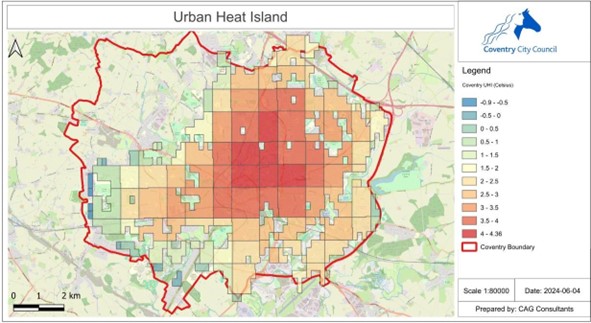
2.8 It is worth noting that obtaining granular data in relation to heat islands for Coventry was challenging. The temperature data provided through the Met Office was either not granular enough or only mapped long term changes in temperatures. A recent study by the University of Manchester has highlighted how significant the UHI risk is. It is noted that there are 69 priority neighbourhoods in need of adaptation to UHI’s in Coventry alone. Given the importance that local heat islands play in amplifying climate risks, there is a specific need to address these data gaps in future reporting processes.
Hazard identification and risk screening
2.9 An initial list of climate change risk was developed using the risks listed in the UK’s Third Climate Change Risk Assessment. Risks related to International Dimensions, any coastal or marine related risks, and some agricultural related risks were removed. The final list or risk included in the assessment is provided in Table 2.
Table 2: Climate change risks for Coventry included in this assessment
| Risk no | Coventry risk or opportunity descriptor |
|---|---|
| N01 | Risks to terrestrial species and habitats from changing climatic conditions and extreme events, including temperature change, water scarcity, wildfire, flooding, wind, and altered hydrology (including water scarcity, flooding and saline intrusion). |
| N02 | Risks to terrestrial species and habitats from pests, pathogens and invasive species |
| N03 | Opportunities from new species colonisations in terrestrial habitats |
| N04 | Risk to soils from changing climatic conditions, including seasonal aridity and wetness. |
| N05 | Risks and opportunities for natural carbon stores, carbon sequestration from changing climatic conditions, including temperature change and water scarcity |
| N06 | Risks to and opportunities for agricultural and forestry productivity from extreme events and changing climatic conditions (including temperature change, water scarcity, wildfire, flooding, coastal erosion, wind and saline intrusion). |
| N08 | Risks to forestry from pests, pathogens and invasive species |
| N11 | Risks to freshwater species and habitats from changing climatic conditions and extreme events, including higher water temperatures, flooding, water scarcity and phenological shifts. |
| N12 | Risks to freshwater species and habitats from pests, pathogens and invasive species |
| N13 | Opportunities to freshwater species and habitats from new species colonisations |
| N18 | Risks and opportunities from climate change to landscape character |
Risk evaluation
2.10 The priority risks identified in the ‘Climate Change Risk and Opportunity Assessment for Coventry’ using exposure, sensitivity and adaptive capacity are provided in Table 3. This table shows that food safety and food security is the main climate change risk for the city. Infrastructure and water availability are also key areas of vulnerability. High priority risks were only found in the Health, Communities and the Built Environment and Infrastructure risk themes. In general, more sensitive risks have higher overall vulnerability.
Table 3: Summary of climate related risks with highest vulnerability in Coventry, identified in the Climate Change Risk and Opportunity Assessment for Coventry.
| Risk and opportunity descriptor | Exposure score | Sensitivity score | Adaptive capacity score | Vulnerability score |
|---|---|---|---|---|
| Risks to food safety and food security | 2 | 3 | 1 | 4 |
| Risks to infrastructure networks (water, energy, transport, ICT) from cascading failures | 3 | 2 | 1 | 4 |
| Risks to public water supplies from reduced water availability | 3 | 3 | 2 | 4 |
| Risks to health and wellbeing from high temperatures | 1 | 3 | 1 | 3 |
| Risks to people, communities and buildings from flooding | 2 | 3 | 2 | 3 |
| Risks to water quality and household water supplies | 2 | 3 | 2 | 3 |
| Risks to health and social care delivery | 2 | 2 | 1 | 3 |
| Risks to education and care home services | 2 | 2 | 1 | 3 |
| Risks from climate change to role of urban ecosystems | 2 | 3 | 2 | 3 |
2.11 Table 4 shows the scoring of risks using the likelihood and impact scoring approach for the present to mid-century scenario. The results from this assessment closely match the scoring for exposure, sensitivity and adaptive capacity scoring used in the ‘Climate Change Risk and Opportunity Assessment for Coventry’.
2.12 Slight differences between these scoring methods are that risks to food safety and food security and risks to public water supplies from reduced water availability are rated at the same level, rather than risk to food security rating slightly higher.
2.13 There are two aspects of risks to food security a portion of which relates to uncertainty of global food supplies and their impact upon food production in other parts of the world combined with food prices. The actions to address such a wider risks relates to increasing provision via the food banks, whereas the promotion of local food growing of fresh vegetable food is about measures such as protecting growing areas and the health of soils from localised flooding and ensuring water supply during periods of drought etc.
2.14 Risks to infrastructure networks from cascading failures also score slightly lower when considering likelihood and impact and risks to businesses from flooding is also included as a new priority risk.
Table 4: Summary of priority climate risks in Coventry for the present to mid-century scenario (2°C change) using likelihood and impact scoring.
| Risk and Opportunity Descriptor | Likelihood Present to Mid Century | Impact Present to Mid Century | Risk Score Present |
|---|---|---|---|
| H09 - Risks to food safety and food security | Likely | Major | 16 |
| I08 - Risks to public water supplies from reduced water availability | Likely | Major | 16 |
| I01 - Risks to infrastructure networks (water, energy, transport, ICT) from cascading failures | Likely | Moderate | 12 |
| B01 - Risks to businesses from flooding | Possible | Major | 12 |
| H01 - Risks to health and wellbeing from high temperatures | Possible | Major | 12 |
| H03 - Risks to people, communities and buildings from flooding | Possible | Major | 12 |
| H10 - Risks to water quality and household water supplies | Possible | Major | 12 |
| H12 - Risks to health and social care delivery | Likely | Moderate | 12 |
| H13 - Risks to education and care home services | Likely | Moderate | 12 |
| N18 - Risks from climate change to role of urban ecosystems | Possible | Major | 12 |
2.15 Table 5 shows the priority risks for the mid to end of century (3°C change) scenario. The results for mid to end century scenario show that risks city wide risks such as risk to health and wellbeing from high temperatures risks to people, communities and buildings from flooding are become more significant. The results also show that there are a number of additional priority risks (such as risks to bridges and pipelines from flooding and erosion and risks to freshwater species and habitats from changing climatic conditions.
Table 5: Summary of priority climate risks in Coventry for the mid to end century scenario (3°C change) using likelihood and impact scoring.
| Risk and Opportunity Descriptor | Likelihood Mid to End Century | Impact Mid to End Century | Risk Score Mid to End Century |
|---|---|---|---|
| H09 - Risks to food safety and food Security | Likely | Major | 16 |
| I08 - Risks to public water supplies from reduced water availability | Likely | Major | 16 |
| H01 - Risks to health and wellbeing from high temperatures | Likely | Major | 16 |
| H03 - Risks to people, communities and buildings from flooding | Likely | Major | 16 |
| B01 - Risks to businesses from flooding | Possible | Major | 12 |
| H10 - Risks to water quality and household water supplies | Possible | Major | 12 |
| N18 - Risks from climate change to role of urban ecosystems | Possible | Major | 12 |
| I01 - Risks to infrastructure networks (water, energy, transport, ICT) from cascading failures | Likely | Moderate | 12 |
| H12 - Risks to health and social care delivery | Likely | Moderate | 12 |
| H13 - Risks to education and care home services | Likely | Moderate | 12 |
| I04 - Risks to bridges and pipelines from flooding and erosion | Likely | Moderate | 12 |
| N11 - Risks to freshwater species and habitats from changing climatic conditions and extreme events. | Likely | Moderate | 12 |
2.16 Table 6 shows the risk profile for Coventry for the end of century scenario (4°C change). There is obviously a high degree of uncertainty in these results. They do however indicate that it is likely that the severity and range risks will increase with increasing global temperatures.
Table 6: Summary of priority climate risks in Coventry for the end century scenario (4°C change) using likelihood and impact scoring.
| Risk and Opportunity Descriptor | Likelihood End Century | Impact End Century | Risk Score End Century |
|---|---|---|---|
| H09 - Risks to food safety and food security | Almost certain | Major | 20 |
| I08 - Risks to public water supplies from reduced water availability | Likely | Major | 16 |
| H01 - Risks to health and wellbeing from high temperatures | Likely | Major | 16 |
| H03 - Risks to people, communities and buildings from flooding | Likely | Major | 16 |
| B01 - Risks to businesses from flooding | Likely | Major | 16 |
| H10 - Risks to water quality and household water supplies | Likely | Major | 16 |
| N18 - Risks from climate change to role of urban ecosystems | Likely | Major | 16 |
| I01 - Risks to infrastructure networks (water, energy, transport, ICT) from cascading failures | Almost certain | Moderate | 15 |
| H12 - Risks to health and social care delivery | Likely | Moderate | 12 |
| H13 - Risks to education and care home services | Likely | Moderate | 12 |
| I04 - Risks to bridges and pipelines from flooding and erosion | Likely | Moderate | 12 |
| N11 - Risks to freshwater species and habitats from changing climatic conditions and extreme events. | Likely | Moderate | 12 |
Priority risk summaries
2.17 The following section provides a summary of the priority risks for Coventry.
Risks to food safety and food security
2.18 Increased temperatures and extreme weather events pose significant risks to both food safety and food security in Coventry. Coventry is not immune to the global impacts of climate change on food production. Failures in grain harvests and other staple crops worldwide due to extreme weather can disrupt food availability in Coventry. This can lead to higher food prices, reduced nutritional quality, and greater difficulty in accessing essential food supplies. Coventry as a Marmot City already experiences dramatic inequalities with differences in life expectancy in the population as high as 10 yrs between those living in the most deprived neighbourhoods from those living in the most affluent parts of the city. Food is already a significant part of the expenditure for low-income families further price rises will result in a decline in the quality of the diet for low-income households with adverse health effects and greater susceptibility to diseases such as diabetes.
2.19 The local impacts of extreme weather also affect food production within Coventry, particularly for low-income families who rely on community gardens and allotments to grow their own food. Changes in temperature, rainfall, and the frequency of extreme weather events can reduce crop yields, affecting food availability for these vulnerable groups. Some allotments are prone to flooding resulting in loss of crops and hotter dry summers with periods of drought will also result in crop failure. In addition, rising temperatures increase the risk of food spoilage and the growth of harmful bacteria during storage, posing a significant food hygiene risk. Improperly stored food can lead to a higher incidence of foodborne illnesses, further straining public health systems.
2.20 Adapting through enhanced food safety regulations, improved food handling education, and robust monitoring of emerging risks can mitigate the impact on public health. Increasing resilience in food supply chains and ensuring robust food security monitoring can minimize costs and protect vulnerable populations from the adverse effects of climate change.
Risks to infrastructure networks (water, energy, transport, ICT) from cascading failures
2.21 Cascading failures occur when vulnerabilities in one infrastructure network causes problems in others, a risk that is exacerbated by extreme weather events and climate change. For example, a flood could lead to the failure of an electrical substation, which is already operating close to capacity. Since water supply in Coventry is 100% electrically pumped, this would result in an immediate disruption to water services. The lack of backup capacity means that this failure could not be quickly mitigated, leading to widespread water shortages. Furthermore, the disruption to the energy network could cascade to other critical services, such as transport and ICT, causing further chaos. For instance, traffic management systems and communications networks could fail, leading to gridlock on the roads and loss of communication capabilities. This interconnected vulnerability highlights the importance of enhancing the resilience of each network to prevent such cascading failures, especially as extreme weather events become more frequent and severe.
2.22 Coventry relies on resilient infrastructure networks for its economy, public safety, and daily life. Disruptions can lead to widespread impacts, affecting thousands in urban areas like Coventry. Proactive adaptation measures, such as enhancing resilience of electricity substations protecting them from flooding using bunding or controllable structures such as flood gates raising cable connections with bentonite on earth mounds or using plinths to raise cabling above ground level and other proprietary methods. Better information sharing among Local Resilience Forums, are essential to minimize disruptions and ensure stable operations across essential services.
Risks to public water supplies from reduced water availability
2.23 Reduced water availability due to climate impacts such as increased temperature and reduced summer rainfall, impacting river flows and groundwater recharge. Coventry's public water supply is crucial for domestic, industrial, and agricultural needs. A deficit impacts daily life, economic activities, and ecological balance.
2.24 Adapting to water scarcity by improving water use efficiency across households and businesses including basic measures such as grey water harvesting in new developments and where possible in retrofits, rainwater collection replacing leaking lead pipes to households with new supply pipes to collecting water from roofs with water butts connected to downpipes, use of trickle irrigation systems, enhancing the water treatment capacity at Finham and enhancing supply infrastructure will ensure sustainability and resilience against future climate variability. Increasing the potable water storage capacity at Draycott Water and from Buxton for supply to Coventry and surrounds Draft Water Resources Management Plan 2024 to accommodate a 12% growth in population and demand thus preventing a 540million litre/day shortfall in a water supply from the Company by 2050 across the Severn Trent Region .
Risks to health and wellbeing from high temperatures
2.25 High temperatures lead to increased illness or mortality, particularly among vulnerable populations like the elderly. This risk is compounded by concurrent crises, such as the COVID-19 pandemic, and exacerbated by the urban heat island effect and poor ventilation in homes.
2.26 Coventry, along with other UK cities, experiences increasingly frequent and intense heatwaves, which can severely impact upon public health, especially in densely populated urban areas. This risk is aggravated by the urban heat island effect and poor ventilation and insulation in homes.
2.27 The Regional study carried out by WMCA suggests that a heatwave incident is highly likely with a 59% chance of at least one event lasting up to 5 days per year rising to 70% by 2050.with an 18% chance of an event serious enough to trigger an Amber Heat Health Alert each year rising to 25% by 2050 assuming a 20C rise in average temperature.
2.28 According to the Grantham Institute's "Turning up the Heat" report, England is ill-prepared for extreme heat events. The report highlights that over half of UK homes are at risk of overheating, with a lack of comprehensive strategies to address this growing threat. The report also notes that in 2022 heatwaves were associated with 2,985 excess deaths in England and cost the UK economy and estimated £260 - 300 million per year. A recent University of Manchester study has also noted that Coventry ranks as the local authority with the 14th highest number of neighbourhoods in England that are vulnerable to heat.
2.29 This under-preparedness, combined with Coventry’s increasing frequency and intensity of heatwaves, underscores the urgent need for robust heat risk management to protect public health.
2.30 It is essential to begin adapting to minimize heat-related health risks, particularly for those most vulnerable. This includes improving building designs to enhance thermal efficiency without compromising air quality or increasing moisture levels. Proactive measures, like setting overheating standards in residential buildings and promoting better ventilation and shading practices within buildings and exterior landscaping, can significantly reduce the adverse health outcomes associated with high indoor temperatures. Additionally, community awareness programs on managing heat stress could enhance resilience. A number of air source heat pumps which are on the market can also be used for cooling. Unfortunately grants from the UK Government for retrofitting air source heat pumps at present does not allow the use of grant funding to assist with cooling. Will make the case for considerations to be made for the use of technology for cooling as part of the assessment process for the new devolved energy funding regime with the WMCA.
Risks to people, communities and buildings from flooding
2.31 The risk of flooding affects people, communities, and buildings significantly due to river, surface and groundwater sources. Flooding impacts include physical damage to properties, potential loss of life and substantial economic costs. Additionally, flooding exacerbates mental health issues like anxiety, post-traumatic stress disorder (PTSD), and depression among affected populations.
2.32 Coventry is particularly vulnerable to flooding from various sources, including river, surface water, groundwater, and sewer systems. Notable areas frequently impacted by flooding include communities along the River Sherbourne, which has experienced repeated fluvial flooding incidents. Additionally, surface water flooding is a significant concern in urban areas such as Earlsdon and Tile Hill, where heavy rainfall can overwhelm drainage systems, leading to waterlogging and property damage. The Coventry Canal and Coombe Pool also pose flood risks due to overtopping or structural failures, which could severely impact nearby properties and infrastructure.
2.33 Proactive adaptation measures are necessary to mitigate risks. This includes tackling flooding at source in upstream catchments to both slow and reduce flow, flood defences, property resilience measures, drainage improvements and integrating Sustainable Drainage Systems (SUDS) in public realm, parks, public highway corridors and tackling urban creep. These steps can significantly reduce the potential physical and economic damage from future flooding events and will require collaboration with neighbouring authorities. A Partnership is already in place for emergency planning which includes Solihull and Warwickshire County Council, and the Partnership is involved in the development of the Adaptation and Resilience Plan which is currently being worked on by all concerned.
Risks to water quality and household water supplies
2.34 Climate change is likely to lead to reduced summer precipitation and increase the likelihood of water scarcity and droughts. This can interrupt household water supplies and degrade water quality, potentially leading to health risks from waterborne pathogens like Cryptosporidium and E.coli, and increased incidents of harmful algal blooms.
2.35 In cities like Coventry, the health risks associated with poor water quality and supply are significant, especially for vulnerable populations. Interruptions in water supply and contamination can lead to widespread health and social issues, straining public health systems and economic stability.
2.36 Adapting to these risks involves improving water infrastructure to handle heavy rainfall and prevent flooding, implementing water-saving measures, the introduction of increased water filtering using retrofit natural and non-natural sustainable drainage solutions in public highway corridors and parks, reducing urban creep together with strengthening water quality improvements in new developments. These actions can mitigate health risks, ensure a stable water supply, and reduce potential economic and social disruptions. The use of SUDs will also help to encourage natural rates of filtration and helping to reduce the runoff of potential pollutants into water courses which would otherwise have an adverse impact upon the ecology of water courses with a loss of biodiversity within freshwater habitats.
Risks to health and social care delivery
2.37 Climate change increases the risk of extreme weather events such as floods and heatwaves that can damage health and social care facilities and disrupt services. This includes overheating of hospitals and care homes, flooding risks to healthcare infrastructure, and impacts on transport and ICT systems essential for care delivery. These effects increase the demand for health services due to the direct impacts on people's health and wellbeing.
2.38 In Coventry, where health and social care infrastructure might be vulnerable, the robustness of these services is crucial for public safety, especially given the projected increase in frequency and severity of extreme weather events. The disruption of these services can have severe immediate health impacts and long-lasting social consequences.
2.39 Adapting to these risks means enhancing the resilience of healthcare buildings against overheating and floods, improving emergency response capabilities, and designing new facilities with future climate scenarios in mind. This includes using building materials and designs that are resilient to extreme weather, and planning healthcare delivery to accommodate increased demands during and after climate events. Strategic and localized adaptation actions are essential to safeguard health and social care services from future climate impacts this should include retrofitting measures where possible with a focus on what can be done within buildings and their exteriors.. Training for social care workers and staff conducting home visits is also crucial. These professionals should be equipped to provide practical, low-cost advice on keeping homes cool during heatwaves. This includes guidance on effective use of ventilation, shading, and simple cooling techniques.
Risks to education and care home services*
2.40 Climate-related risks to education and care services in Coventry are significant and complex. Overheating in schools and care homes can impair learning and cognitive performance in children and heighten discomfort and health risks for elderly residents. Increased flooding risks can disrupt the operations of these essential services.
2.41 Heat stress particularly impacts vulnerable groups, including young children, the elderly, and those with medical conditions such as Chronic Obstructive Pulmonary Disease (COPD) and heart disease. Staff working in schools, nurseries, care homes, and community outreach services need to be particularly vigilant in these conditions.
2.42 Beyond education and care homes, other critical services, including those supporting people in their homes, must also adapt to these climate-related challenges. This means updating building designs and infrastructure across a broader range of services to effectively manage heat and flood risks. In Coventry, it is essential that facilities, whether educational, residential, or community-based, remain safe and functional under future climate scenarios.
2.43 Adapting to these risks requires a comprehensive approach that includes implementing heat management strategies, improving flood resilience, and ensuring continuity of services. Strategic planning is key to maintaining the resilience of Coventry’s educational and care systems.
2.44 Additionally, specific training for staff is essential. This training should cover how to address heat stress and other climate-related challenges within facilities and provide guidance on helping individuals and families manage during extreme temperature events.
*The national risk descriptor for this risk is “Risks to education and prison services”. However, there are no prisons or offender institutions in Coventry. We have amended this risk to include care homes as they are a particularly important facilities with vulnerable elderly residents most affected by extreme heat.
Risks from climate change to role of urban ecosystems
2.45 Climate change poses significant risks to urban ecosystems through increased temperatures, pollution, habitat degradation, and the spread of invasive species. These factors can lead to a decline in biodiversity and affect ecosystem services in Coventry, a city already facing challenges with blue and green infrastructure.
2.46 While biodiversity is important, the focus should be on developing ecologically sensitive approaches that mimic natural ecosystems. This strategy can reduce the need for costly interventionist land management practices. By creating systems that are closer to natural ecosystems, we can enhance resilience against climate impacts such as heatwaves and flooding, while potentially improving air quality, water quality and providing recreational spaces.
2.47 In some cases, the use of non-native, climate-adapted species may be appropriate, particularly in areas facing heat stress and low water availability. These species can survive in challenging conditions and contribute to cooling urban areas. The Forestry Commission for example recommends changes in provenance of genetic stock using seeds from trees located 2 degrees south of the Coventry location which are closer to the projected climate for the city in the not-too-distant future.
2.48 Adapting to these risks will strengthen Coventry's resilience against climate impacts, potentially improve quality of life for residents, and create a more sustainable urban environment. This approach balances ecological considerations with practical, cost-effective solutions for climate adaptation.